
UK Gambling Commission and Rugby Betting: Licensing, Levy, and Player Protection
 Available in US
The regulator behind every UK rugby bet
Every UK-licensed rugby bookmaker operates under the Gambling Commission’s framework. That framework determines what affordability checks you will encounter, what self-exclusion options you have, how complaints are resolved, and how the operator’s marketing can target you. The 13.5 million average monthly active online accounts in the UK in early 2025 all sit under this regulatory architecture, whether the user knows it or not.
The framework has been actively reshaped in recent years. As one government minister put the issue at the most recent BGC AGM, one of the biggest issues raised with her as Gambling Minister is advertising — and the industry has been tasked with doing more to ensure gambling advertising and sponsorship is appropriate, responsible, and does not exacerbate harm. That posture from the political level shapes everything operators have to do at the customer level.
UKGC licensing basics
The Gambling Commission issues operating licences to companies offering gambling services in Great Britain. The licence covers specific activities — sports betting, online casino, lottery, bingo — with separate licence categories for each. Personal Management Licences are required for senior individuals at operators, including those responsible for compliance and anti-money-laundering.

What licensing means in practice for a rugby bettor. The operator must verify your identity (KYC), enforce age verification (no under-18s), provide self-exclusion tools, contribute to research, education, and treatment (the statutory levy, discussed below), and follow advertising and marketing codes. Failure on any of these produces regulatory consequences ranging from fines to licence revocation.
Verifying that an operator is properly licensed is straightforward. The Commission’s public register lists every licensed operator. Operators must display their licence number in the footer of their UK-facing pages. If the licence number is not visible or the operator is not in the public register, the operator is not legally operating in the UK regardless of what their marketing claims.
The 2023 white paper and rugby
The 2023 government white paper on gambling reform set out a wide package of changes, several of which have direct implications for rugby betting. Affordability checks, the statutory levy, advertising restrictions, and product-design rules were all on the table.

The minister’s framing matters. At the BGC AGM 2025, the Minister for Gambling spoke directly to the industry’s responsibilities. “One of the biggest issues raised with me as Gambling Minister is advertising,” she said. “I have tasked the industry with doing more to work together to ensure that gambling advertising and sponsorship is appropriate, responsible, and does not exacerbate harm.” That statement frames how the regulator views the operator-customer relationship going forward — not as a transactional one but as one carrying ongoing duties of care.
For rugby specifically, the most visible white-paper effect has been on sponsorship. The voluntary code on front-of-shirt sponsorship that the Premier League agreed in April 2023 — and which takes effect from the end of the 2025/26 season — set a precedent that other sports have followed in cross-sport codes. The implications for rugby club sponsorship and matchday gambling advertising are real and ongoing.
Affordability and KYC checks
The affordability check framework is the white-paper change most likely to affect individual bettors directly. Operators are required to monitor customer activity for signs of harm and to conduct enhanced checks when specific thresholds are met. The triggers include deposit volumes, betting patterns, and demographic risk factors.
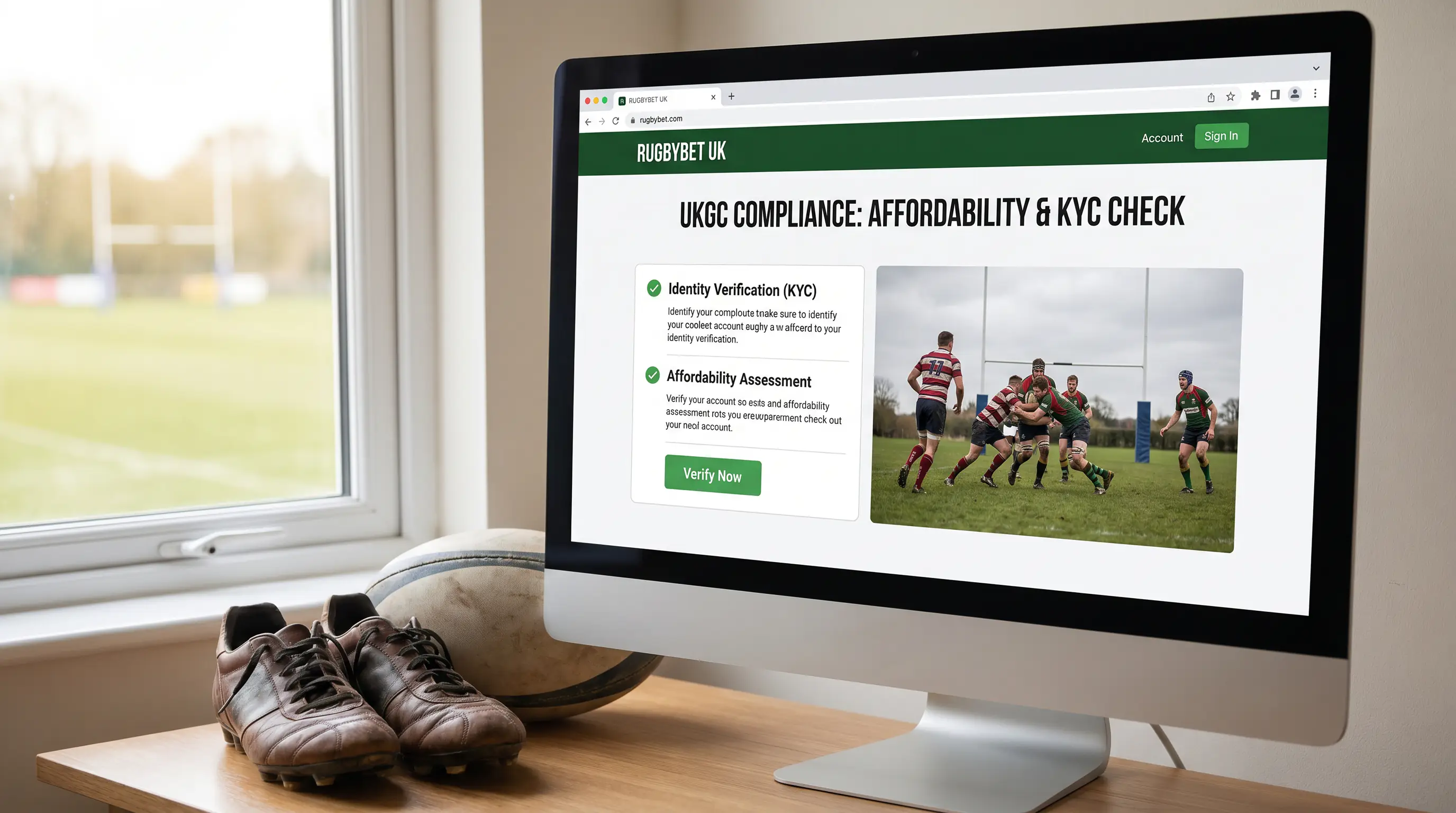
What an affordability check looks like in practice. The operator requests evidence of income — payslips, bank statements, or other documentation. The check is intended to confirm that the customer’s betting is within sustainable financial means. Refusal to provide documentation typically results in restricted account access until the documentation is provided.
The thresholds vary by operator and have evolved since the white paper. Common triggers include £500 net deposits over 30 days, £1,000 over 90 days, or specific pattern signals (rapid escalation of stake size, late-night activity bursts, attempted deposits above set limits). The thresholds are not published precisely because doing so would allow them to be gamed.
The friction is real. Bettors who view their stakes as comfortably within means can find the documentation request intrusive. The regulator’s position is that the friction is the point — checks are designed to interrupt potentially harmful patterns even where the customer themselves does not perceive the harm.
Statutory levy explained
The statutory levy is a mandatory contribution from licensed gambling operators to fund research, prevention, and treatment of gambling-related harm. It replaces a previous voluntary contribution system that the white paper concluded was insufficient.

The levy is a percentage of operators’ Gross Gambling Yield (GGY) — the total amount staked minus winnings paid out, before operational costs. Different sectors pay different rates: online casino at higher rates than online betting, with adjustments for smaller operators. The levy funds NHS treatment services, research grants, and educational programmes.
For rugby betting specifically, the levy does not directly change the prices you see. Operators absorb the cost into their margin structure, which is already reflected in the 93 to 98.5 percent payout range across UK rugby bookmakers. Whether the levy has caused a measurable shift in average margins is debated within the industry; the operator perspective is that the cost has compressed promotional spending and tightened account-level promotional generosity rather than shifting headline prices materially.
Complaints and ADR
Complaints process for UK-licensed gambling operators follows a defined sequence. First, internal complaint to the operator — operators are required to maintain a published complaints procedure and to respond within set timeframes. Second, escalation to an Alternative Dispute Resolution (ADR) provider — these are independent bodies that adjudicate disputes between operators and customers. Third, regulatory complaint to the Gambling Commission, though the Commission does not adjudicate individual disputes but does use complaint data to inform regulatory action against operators.

The ADR step is the meaningful one for individual bettors. Decisions by ADR providers are typically binding on the operator (if the operator has agreed to that ADR’s terms) and provide a structured resolution path that does not require court action. Common dispute types include disputed bet settlements, account closure decisions, and bonus terms interpretations.
Bettors who escalate complaints find the process slow but functional. Resolution times of two to six weeks for ADR decisions are common. The framework is not perfect — operators sometimes win disputes that customers feel were unfair — but the existence of structured ADR is one of the clearer benefits of the UK-licensed market versus offshore alternatives.
The regulator’s evolving posture
The relationship between the Gambling Commission, the Department for Digital, Culture, Media and Sport, and the industry has been actively renegotiating since the 2023 white paper. Affordability check frameworks have evolved, levy mechanisms have been formalised, and advertising restrictions continue to develop. The minister’s framing — that the industry must do more on advertising and sponsorship — points to where future changes are most likely.
For rugby bettors specifically, the practical changes in recent years include more frequent KYC and affordability friction, more standardised safer-gambling tools, and clearer ADR pathways. The cost is procedural friction; the benefit is structural protection. Whether the trade-off feels worth it depends on whether you have personally needed the protections. For the related ground on sponsorship specifically, my piece on sponsorship ban impact on rugby covers the cross-sport-code framework that builds on the same white-paper foundations.
