
UK Rugby Bookmakers: Comparing Payouts, Market Depth, and Regulation
 Available in US
The single biggest mistake I see new punters make is choosing a bookmaker based on the size of the welcome offer. A £30 free bet looks generous on the homepage. What it doesn’t tell you is whether the operator’s underlying pricing is 96% payout or 93% payout — and across a year of regular rugby betting, that three-point gap is worth dozens of times more than any signup bonus. This article is about the things that actually matter when comparing UK rugby sportsbooks: payout, market depth, licensing, and live coverage. The bonus is a footnote.
UK rugby payout percentages currently range from 93.00% to 98.50% across the major operators. Market depth varies even more sharply — between 3 and 5 rugby markets per match at the leaner end, up to 10-15 markets on smaller operators and 150-plus in-play markets on the top sportsbooks during big fixtures. Those gaps are the real differentiators. Everything else is marketing.
The framing below is built around what actually matters once you’re betting regularly. I’ll walk through licensing as the regulatory floor, payout as the recurring cost of doing business, market depth as the analytical surface area, live streaming as the in-play infrastructure, rugby-specific specialisation as the operator-level edge, and safer gambling as the discipline layer that protects you from yourself. Each section is a lens. Combine them and you’ve got a working framework for picking an operator that fits your style rather than chasing the loudest signup banner.
Licensing and the UKGC baseline
Every legitimate UK rugby bookmaker holds a licence from the UK Gambling Commission. That licence is the floor, not the ceiling. It means the operator complies with affordability checks, KYC verification, anti-money-laundering procedures, and the standard suite of consumer protections. Without a UKGC licence, the operator cannot legally serve UK customers regardless of what jurisdiction they’re based in.
Affordability checks have become a more prominent part of the licensing landscape in recent years. The 2023 White Paper sketched out a framework that operators have been progressively implementing. Baroness Twycross, the UK’s Gambling Minister, summarised the regulatory direction in her speech at the BGC AGM: “One of the biggest issues raised with me as Gambling Minister is advertising. I have tasked the industry with doing more to work together to ensure that gambling advertising and sponsorship is appropriate, responsible, and does not exacerbate harm.” The ministerial focus on advertising and sponsorship is filtering through to every UK-licensed operator’s compliance roadmap.
For the punter, the practical impact of UKGC licensing is twofold. First, you have legal recourse if anything goes wrong. The Independent Betting Adjudication Service and other regulator-approved ADR providers can resolve disputes that the operator won’t handle. Second, your funds are held in segregated accounts that should be protected if the operator becomes insolvent. Neither protection exists if you’re betting with an offshore site that isn’t UKGC-licensed.

The Gambling Commission’s most recent operator data put the average monthly count of active online accounts in the UK at 13.5 million in the first quarter of 2025, up 2% year-on-year. That’s the population using UKGC-licensed sites for online gambling broadly. The rugby-specific subset is smaller, but the total addressable market for licensed UK sportsbooks is genuinely substantial, and the regulatory machinery scales accordingly.
One question I get a lot: does an operator’s specific UKGC compliance record show up in pricing or product quality? The short answer is sometimes. Operators currently in dispute with the regulator over historical conduct issues occasionally tighten their terms or restrict winning customers more aggressively. A clean compliance record correlates with smoother customer service and faster withdrawal processing. Both regulator and trade press reports on specific operator decisions are publicly searchable, and a quick check before opening a new account is time well spent.
How payout percentage actually works
Payout percentage is the inverse of the bookmaker’s overround. If a match has three possible outcomes priced at 2.00, 25.00, and 2.00, the implied probabilities sum to 50% + 4% + 50% = 104%. The 4% above 100% is the overround. The payout percentage is 100/104 = 96.15%. That number is what you get back, on average, on every pound staked across that market.
UK rugby payout percentages range from 93.00% to 98.50% depending on operator and market type. A 98% payout means the bookmaker takes a 2% margin. A 93% payout means a 7% margin. Across a thousand bets at £10 each, the difference between 98% and 93% payouts is £500 of expected return. That’s a serious sum for any committed punter.
The headline payout figure usually refers to the main match-winner market on top fixtures. Drill into secondary markets — tryscorer, half-time/full-time, novelty specials — and the payout percentage drops sharply. First tryscorer markets often run at 75-85% payout because the bookmaker is spreading margin across many possible outcomes. Outright markets on long tournaments can run as low as 80% because the bookmaker is hedging an eighteen-month liability.
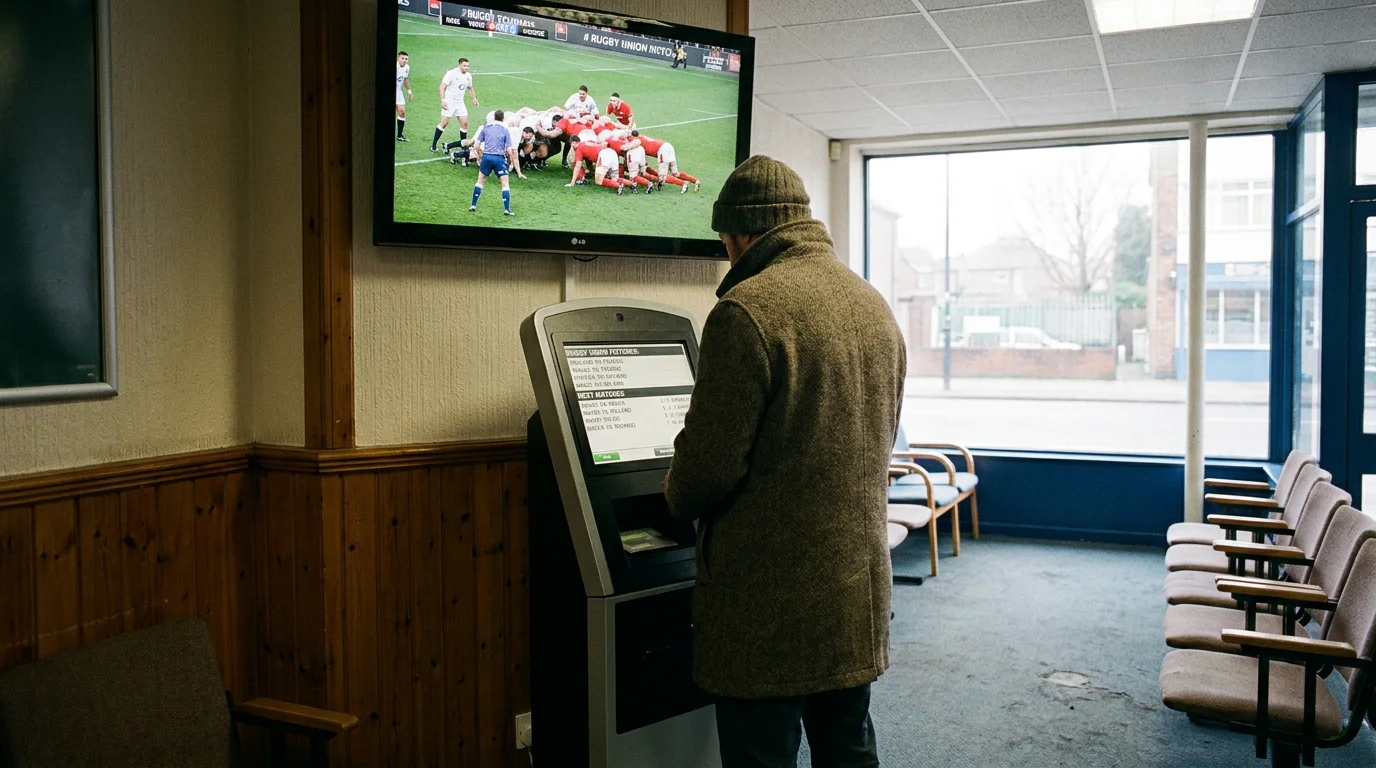
What this means in practice: a punter who only bets main handicap and main totals will experience close to the headline payout. A punter who plays tryscorer doubles, half-time/full-time, and Bet Builder specials will experience an effective payout 5-10 points lower than the headline figure. Your market mix determines your actual cost of doing business with the operator. My deeper write-up on the methodology lives in how rugby bookmaker payout percentages are calculated for anyone who wants to work through the maths step by step.
Market depth and what 150-plus actually looks like
On a top Six Nations Saturday fixture, the major UK operators list 150-plus in-play markets per match. The leanest UK rugby operators list 3-5 markets per match. That gap is bigger than most punters realise until they’ve actively shopped between operators.
The high-depth operators carry the full menu — main match result, double chance, draw no bet, alternative handicaps stacked five-deep on either side, totals at half-point intervals from 30.5 to 60.5, tryscorer markets in three time windows, race-to markets at four point thresholds, half-time markets across all the above, sin-bin specials, scoring methods, sequencing markets, plus a hundred-plus in-play refresh markets that appear during the match itself. The lean operators carry match winner, handicap, totals, and maybe first tryscorer. That’s it.

What does market depth give you in practice? Three things. First, more entry points for the same fundamental read. If you think a match will be high-scoring, a deep operator lets you express that view through alternative totals at multiple lines, first-half totals, and team totals. A lean operator forces you into the single headline over/under.
Second, deeper specials reward situational reads. If you spot a specific tactical pattern — a particular set-piece weakness, a kicker out of form, a referee with a strict breakdown emphasis — deep operators give you the markets to express that read. Lean operators don’t carry the relevant specials.
Third, in-play flexibility. The 150-plus in-play markets on top operators let you trade match action in real time. Sin-bin minutes can be specifically bet. Next tryscorer refreshes after each score. Race to next 10 points opens and closes within minutes. That density of in-play coverage is genuinely unique to the top UK operators and it’s invisible to anyone who only ever bets pre-match.
The trade-off is that high-depth operators sometimes carry slightly worse payout on the headline markets. They’ve invested in the technology to support market depth, and they recover the cost somewhere. The shrewd move is to use multiple operators — a high-payout lean operator for headline bets, a high-depth operator for specials and in-play.
There’s a measurable middle ground worth knowing about. Operators that offer 50-75 markets per match — neither the leanest 3-5 nor the deepest 150-plus — often deliver the best blend of payout and variety. The pricing teams have enough budget to cover the markets that matter without diluting the headline margin. For a punter who bets handicap, totals, and one or two specials per match, that middle tier is often the sensible default.
Live streaming and in-play coverage
Live streaming is a significant differentiator in modern UK rugby betting. The top operators carry live streams for the major competitions — Six Nations, Premiership, URC, Champions Cup, Super League — though the specific rights vary by operator and by competition. The detail to check before opening an account: does the operator stream the specific competition you bet on most? A Super League punter and a Six Nations punter may need different operators for streaming.
The quality of the stream matters too. Latency between the live broadcast and the operator’s video feed is typically 5-15 seconds. That delay means the in-play markets refresh ahead of what you can see on screen. If you’re trying to trade in-play based on what’s happening live, the latency is a structural disadvantage unless you’ve also got the broadcast feed open on a separate device.

The “stream + bet” feature on most major UK operators lets you watch and bet from the same interface, with the streaming pane and the markets sitting side-by-side. The convenience is real, but the latency issue still applies. Casual punters who just want to watch and dabble find the integrated stream excellent. Serious in-play bettors run a separate live TV feed alongside their betting screen to eliminate the lag.
Charlon Muscat at FIRST.com captures the streaming-plus-markets package well: “The best rugby betting sites in the UK cater to both union and league fans, spanning competitions like the Rugby World Cup, Six Nations, Gallagher Premiership, Super League, and Challenge Cup. You can stream matches, claim bonuses, and explore markets such as handicaps, first try scorer, winning margin, and total points.” That bundle — streaming plus deep markets — is the modern standard for a top-tier operator.
Rugby-specific specialisations across operators
Some operators genuinely specialise in rugby. The pricing teams at the larger UK sportsbooks employ rugby-dedicated traders who price the markets manually rather than relying on auto-generated lines. Those operators tend to have sharper opening lines but also tighter margins on rugby-specific markets. Smaller operators often run rugby through a generic auto-pricing engine, which produces softer opening lines but with wider margins.
The dedicated-rugby operators usually offer more pre-match prop variety — sin-bin specials, scoring sequences, set-piece props — and they update lines faster on team news. The auto-pricing operators are softer on prop markets in the immediate aftermath of team announcements because the algorithm hasn’t fully digested the line-up change. That’s a small but exploitable window for punters who track team news in real time.
Operators also vary in their handling of major tournament-specific markets. Six Nations specifically pulls in additional pricing depth across all UK operators — Wooden Spoon markets, Triple Crown markets, championship-plus-Grand-Slam parlays, top tryscorer in the tournament — but the depth of those markets varies widely. The operators with serious rugby pedigree carry deeper Six Nations menus than the generalist operators.
One area where smaller operators sometimes outperform: specific competition coverage. A few operators have built reputations around comprehensive Premiership or Super League coverage that competes with the biggest sportsbooks despite a much smaller overall handle. If your rugby betting is concentrated on one specific competition, it’s worth shopping specifically for an operator known for that league rather than defaulting to the household names.
Cash out, bet builder, and feature comparison
Cash out is now standard across every major UK rugby operator, though the offered fair-value percentage varies. The strongest cash-out offers sit around 90-92% of fair value on stable in-play positions; the weakest run as low as 75-80%. That gap matters if you actually use cash out routinely. A 90% cash-out operator is a meaningfully better proposition than a 80% one across a season’s worth of in-play trading.
Bet builders — the feature that lets you combine multiple selections from the same match — are now ubiquitous. The variety differs by operator. Some operators allow combinations across 10-plus markets from a single match. Others limit you to 3-4 core selections. The breadth of allowed combinations is a proxy for how seriously the operator takes prop bettors.
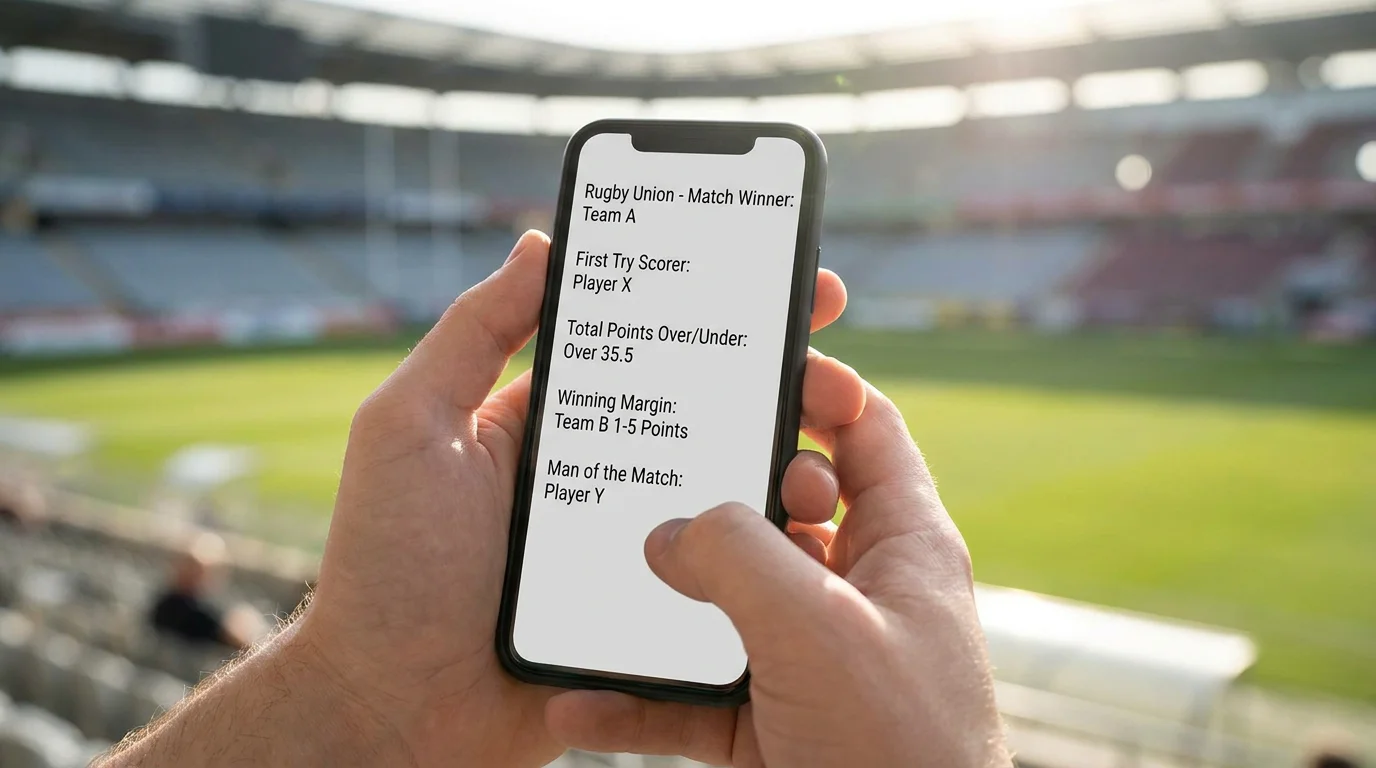
Partial cash out is the more advanced feature. It lets you settle a portion of a bet and leave the rest running. Operators that offer partial cash out as a standard feature are generally aimed at sophisticated punters. Operators that don’t offer it usually target a more casual recreational base.
Auto cash out — pre-setting a trigger price at which the system cashes out for you automatically — is the third feature in this group and the most useful for in-play trading. If you’re going to step away from your screen during a match, auto cash out lets you lock in a target outcome without having to monitor the live price.
Safer gambling tools across operators
Every UKGC-licensed operator is required to offer the core safer gambling tools: deposit limits, loss limits, time-out periods, self-exclusion, and GamStop integration. Compliance with this baseline is mandatory. Where operators differ is in the prominence and usability of these tools.
The 2025 Safer Gambling Week generated a 41% increase in deposit limits set across UK operators, with 281,000 limits set in a single week. That uptick reflects both the success of the awareness campaign and the increasing comfort UK punters have with using these tools proactively. Setting a deposit limit before you start betting is one of the smartest moves a punter can make — it forces the discipline upfront rather than after a chasing session.

The best operators surface these tools clearly in the account management interface. The weaker operators bury them under menus that take three or four clicks to find. The usability difference matters when you’re trying to set a limit in the moment, particularly if you’re starting to feel the urge to chase a loss.
Reality checks — periodic pop-ups during a session showing how long you’ve been logged in — are another required feature. Most operators set the default to one hour. Some let you customise the interval down to 15 or 30 minutes. If you’re prone to losing track of time during in-play sessions, shortening the reality check interval is a free way to maintain awareness.
What I actually look for in a UK rugby sportsbook
Stepping back from the feature-by-feature comparison, the things that matter to me when I pick an operator are simple and they’re not in the welcome offer. I want consistent payout above 96% on main markets. I want enough market depth to express specific reads on tryscorer, totals, and handicap with alternative lines. I want reliable live streaming for the competitions I bet most. I want fast withdrawals without unnecessary friction. And I want a safer gambling interface that doesn’t make me click through five menus to find the deposit limit.
The welcome offer is a one-time consideration. The payout, market depth, streaming quality, and platform stability are recurring concerns that compound over months and years. If you’re new to rugby betting, ignore the bonus and pick the operator that scores well on the four recurring factors. The signup bonus will be there next year — your money won’t, if you’ve picked badly on payout.
One last note. Holding accounts with two or three operators is the practical move for any serious rugby punter. No single operator wins across every market category. The combination of a high-payout lean operator and a high-depth dedicated-rugby operator gives you the best of both worlds, and you can route each bet to whichever sportsbook offers the better price on that specific market. That’s the closing-line-value discipline applied at the operator-selection layer, and it pays for itself within a month of regular betting.
The discipline behind operator selection mirrors the discipline behind individual bet selection. Information beats marketing. Payout beats welcome offer. Market depth beats brand recognition. The reputation of the household-name sportsbooks in the UK is built on years of marketing spend, not on price quality. Some of the best-priced rugby operators in the country are names most casual punters have never heard of. Find them, open accounts, and compare prices across your usual betting menu for a fortnight. The difference is usually visible within five or six placed bets.
