
Rugby Accumulator Betting: Acca Maths, Correlated Picks, and Bet Builder Pitfalls
 Available in US
The format every Six Nations weekend lives on
An honest confession to start: I have built more bad accas than good ones over the years. The format is genuinely irresistible during big rugby weekends — four matches on a Saturday, three or four selections feels reasonable, the projected return looks exciting. Then the third leg dies in the 75th minute and you remember why these bets exist.
That said, accumulators are not stupid. Used carefully — with the right grasp of the maths and a clear-eyed view of correlation — they are a legitimate part of a betting bankroll. Operators position them well: the breadth of rugby markets across union and league, including handicaps, first try scorer, winning margin, and total points, gives accumulator builders genuine choice across competitions. The question is whether you use that choice to add value or to lose it.
Acca maths fundamentals
The basic maths is simple multiplication of decimal odds across each leg, but the implications are worth restating. A three-leg acca where each leg prices at 2.00 returns 8.00 — every leg needs to win, but the implied combined probability is just 12.5 percent. Stack five legs at 2.00 each and the combined price reaches 32.00, with a true probability of about 3.1 percent.

The overround compounds across legs. If each individual market has a 5 percent overround, a five-leg acca carries the equivalent of a 27 percent combined overround. That is the structural reason accas favour the bookmaker: the more legs you stack, the wider the implicit margin you pay.
What that means for sensible acca construction: shorter accas with strong individual edges work better than long accas with marginal edges. A three-leg acca where each leg has a genuine 5 percent edge over the price is materially profitable in the long run. A seven-leg acca with the same per-leg edge gets eaten by compounded overround before the maths can express itself.
A workable Six Nations acca template
The Six Nations weekend is the single most popular acca event in UK rugby betting. Five matches across two or three days, plus heavy promotional pricing from operators chasing volume. The combined attendance of 1,050,465 across the most recent 15-match Six Nations sample tells you how much interest is concentrated in this window.

My template for a Six Nations weekend acca looks like this. Three legs, no more — usually one handicap, one totals, and one team-specific market (winning margin band, half-time leader). Avoid first try scorer on more than one leg per acca, because the variance is too high to compound. Keep all three legs in the same competition or close-by competitions to maintain shared context.
Stake sizing matters more than acca length. I bet smaller stakes on accas than I do on single bets — typically half the unit size — because the variance is materially higher. A losing run on accas can produce six or seven blank weekends in a row before the maths starts working.
Bet builder correlations
Bet builders are accas with a specific feature: all legs come from the same match. The marketing pitch is “build your own price”; the practical reality is “price multiple correlated outcomes from one fixture”.
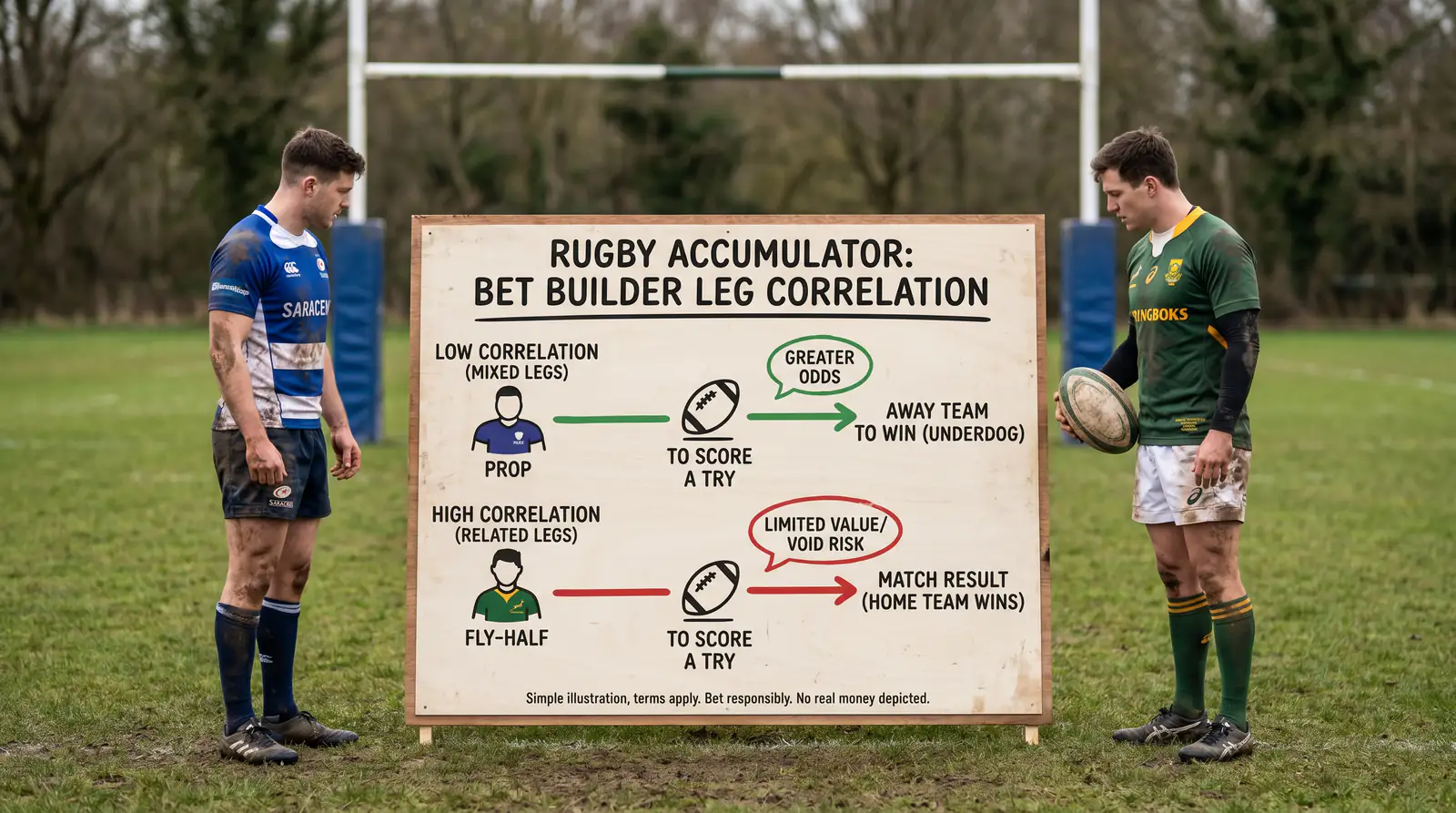
The correlation problem is significant. If you build a bet with “Team A wins” + “Team A scores 30-plus points” + “Player X scores a try”, all three outcomes are positively correlated — they all depend on Team A dominating the match. The bookmaker price for the bet builder reflects whether the operator models this correlation or just multiplies the individual probabilities.
Operators that use simple multiplication offer better value to the bettor on correlated combos. The maths: if Team A wins prices at 1.40, scores 30+ at 2.50, and Player X to score at 3.00, simple multiplication gives 10.50. Correlation-aware pricing might price the bet at 7.50 to 8.50. If you can find the 10.50 price, you are getting genuine edge from the operator’s pricing assumption.
The reverse trap: negatively correlated bet builder legs are bad value. “Team A wins” + “Player Y from Team B to score first try” — the second leg is more likely if the first is wrong. Simple multiplication understates the combined probability, but bookmakers rarely give you value on combinations where they would be paying you for compounded uncorrelated outcomes. The market does not work that way.
Acca insurance and promotional terms
Most UK operators run some form of acca insurance: refund your stake if one leg lets you down on a 4+ or 5+ leg acca. The marketing implies free protection. The reality is more nuanced.

The terms matter. Some insurance pays back stake only, capped at modest amounts. Some pays back as free bet credit with wagering requirements. Some applies only to specific market types (no first-try-scorer legs, no in-play legs). The headline offer rarely matches the practical value.
My approach: I read the insurance terms before I build the acca, not after. If the insurance pays back £25 maximum on stakes up to £50, the effective protection is a partial discount, not a free roll. That changes how I value the acca relative to taking three single bets at the same effective price.
Bankroll rules for acca players
The discipline that has kept me solvent across years of acca play is simple. Smaller unit size than single bets (typically half). Acca-specific budget set monthly — once it is gone, the format is closed until next month. Never chase losses with longer accas at higher prices — that is the path to ruin.

The maths supports the discipline. A five-leg acca with 25.00 combined odds has roughly 4 percent implied probability of winning. Even if your true probability is 5 percent — a clear edge — variance means losing streaks of 10, 15, or 20 accas in a row are entirely normal. Without a bankroll structure that survives those streaks, the edge is theoretical.
When accas are genuinely worth building
The honest answer: less often than the marketing suggests. Accas are worth building when you have three independent strong reads on three matches and the cumulative price reflects a genuine edge after compounded overround. Accas are not worth building because the weekend has four matches on the card and a long-shot price looks fun.

The 150-plus in-play markets on big matches mean the alternative is rich. Single bets in specific live windows often produce better risk-adjusted returns than accas, with less variance and clearer feedback on which decisions worked. The breadth of markets across rugby — handicaps, first try scorer, winning margin, totals — is best exploited as a portfolio of single positions, not as a stack of co-dependent acca legs. For the bet builder mechanics specifically, see my piece on rugby bet builder deep dive.
