
Rugby Odds Formats: Fractional, Decimal, and How to Convert in Seconds
 Available in US
The setting nobody changes and the cost of leaving it default
UK bookmaker apps open in fractional odds by default. Most British bettors never change the setting, even though decimal odds make implied-probability maths roughly five times faster. The format is not a moral choice — both convey the same information — but the speed of mental conversion matters when you are line-shopping across operators or evaluating live prices in 30 seconds.
Ante-post markets show the cost clearly. As one Betfair spokesperson summarised the Rugby World Cup 2027 outright board, South Africa are 9/4 favourites to win the Rugby World Cup for a third successive time in 2027, the Boks have cemented their position as world number one and are likely to collide with 7/2 second-favourites New Zealand in the quarter finals, while England’s strong autumn form sees them as fourth favourites at 5/1. Reading that as 3.25, 4.50, and 6.00 — the decimal equivalents — produces the implied probabilities at 30.8, 22.2, and 16.7 percent in seconds rather than minutes. The information is the same; the speed is different.
Fractional odds explained
Fractional odds express the profit relative to the stake. A 5/1 price means a £1 stake returns £5 profit plus the original £1 back. A 7/2 means £2 staked returns £7 profit. A 1/2 means £2 staked returns £1 profit — odds-on, meaning the favourite is priced shorter than even money.
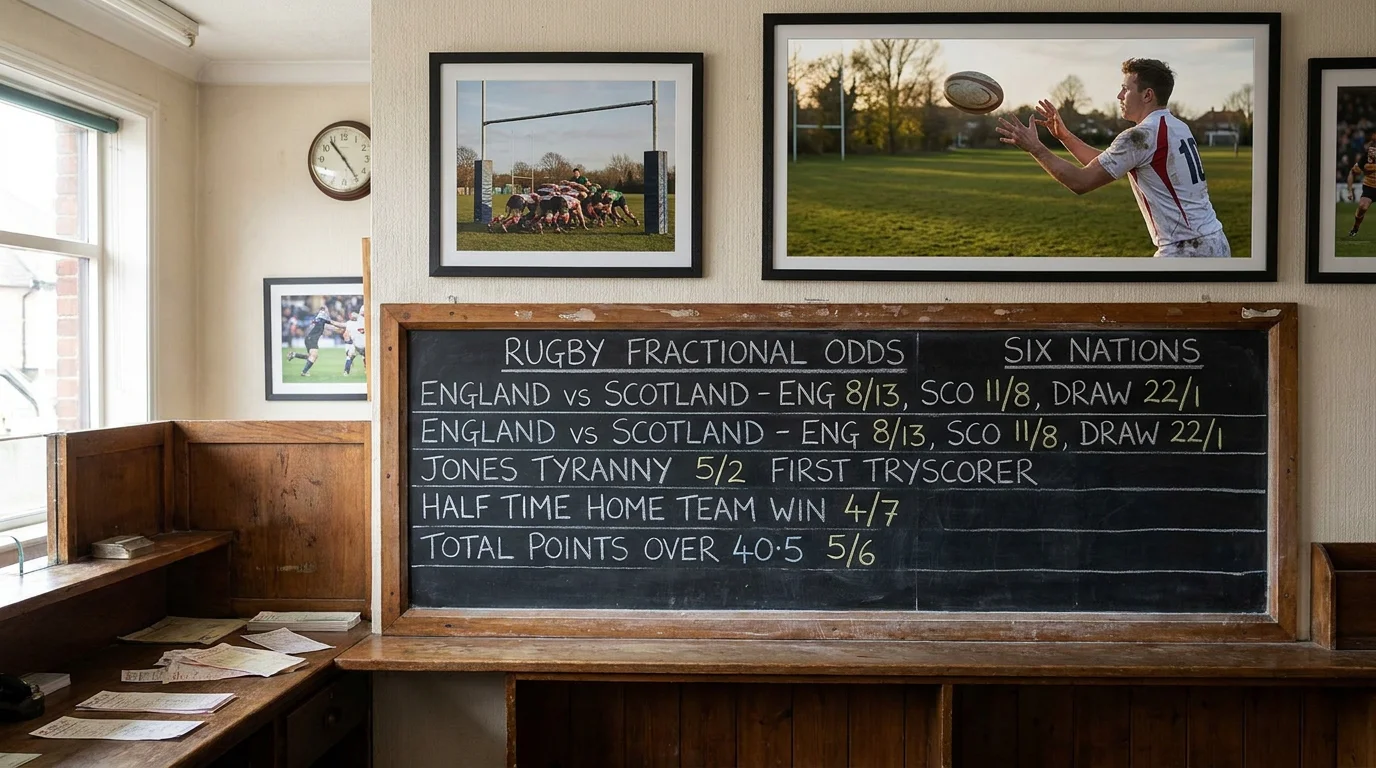
The format originated in horseracing and persists in UK sportsbooks because of cultural inertia. It works perfectly well for whole-number ratios but gets clumsy for non-rounded prices: 11/8, 13/10, 15/8, 5/6. Mental conversion to a price-per-£1 staked requires arithmetic that decimal odds skip entirely.
To convert fractional to implied probability: take the denominator divided by (numerator plus denominator). A 5/1 is 1/(5+1) = 16.7 percent. A 9/4 is 4/(9+4) = 30.8 percent. A 7/2 is 2/(7+2) = 22.2 percent. The maths is doable but slow; the same calculation in decimal is just 1 divided by the price.
Decimal odds explained
Decimal odds express the total return per £1 staked, including the original stake. A 2.00 decimal price returns £2.00 total — £1 stake plus £1 profit. A 1.50 returns £1.50 — £1 stake plus 50p profit. A 5.00 returns £5.00 — £1 stake plus £4 profit.
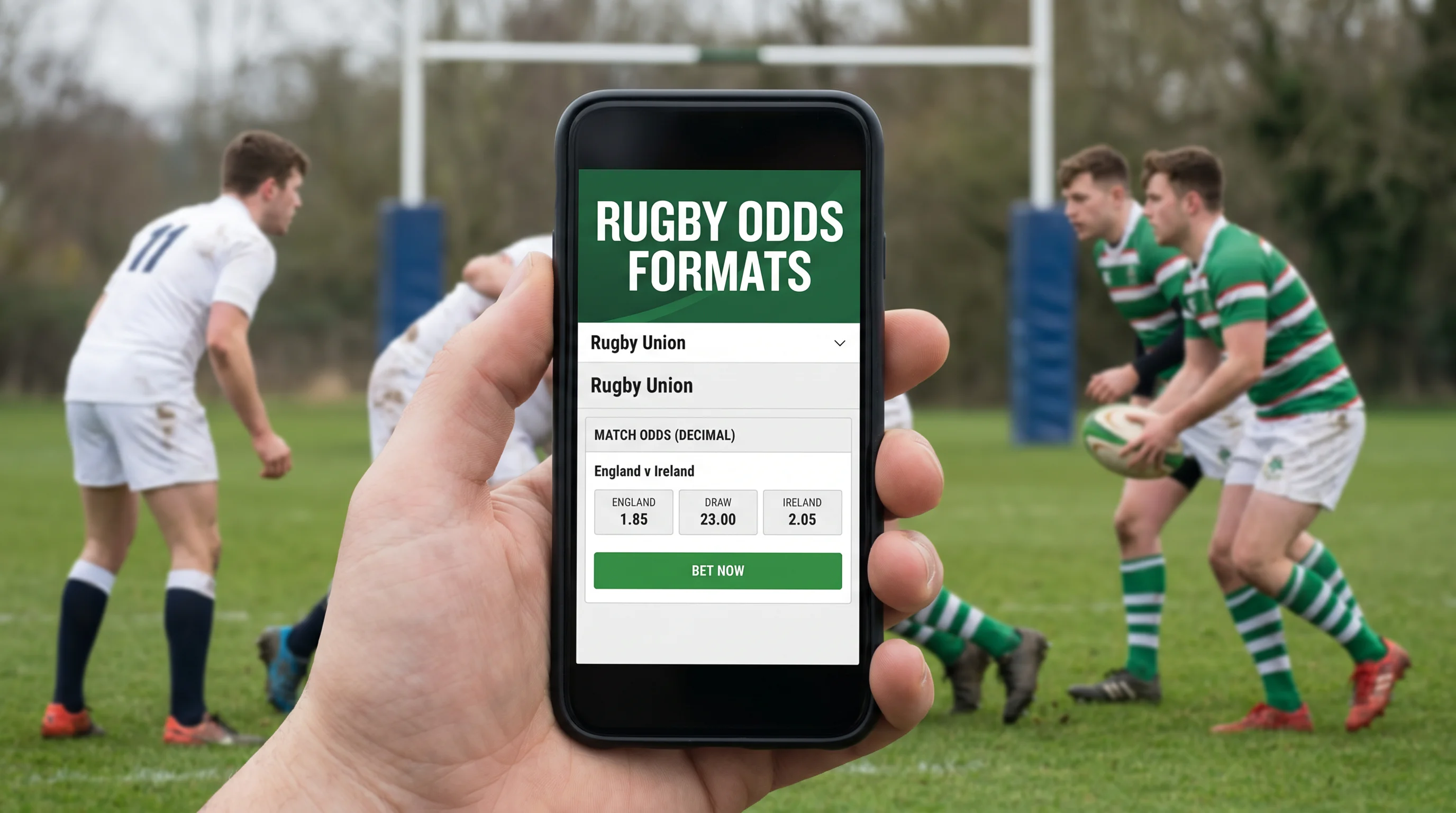
Implied probability conversion: 1 divided by the decimal price. A 2.00 implies 50 percent. A 3.00 implies 33.3 percent. A 1.50 implies 66.7 percent. The maths is identical for any price — no special handling for odds-on or odds-against, no fractions to simplify, no mental gymnastics. This single feature is why decimal odds dominate professional betting and finance globally.
The Betfair quote above puts South Africa at 9/4 — that is 3.25 in decimal. The implied probability calculation is 1 divided by 3.25, which is 30.8 percent. The same calculation in fractional form requires more arithmetic. For a bettor evaluating 20 to 30 prices across a Saturday’s fixtures, that speed advantage adds up.
American moneyline and conversions
American odds — also called moneyline odds — are common on US sportsbooks and increasingly visible on UK operators marketing to US-facing players. The format uses positive and negative numbers around a baseline of 100.
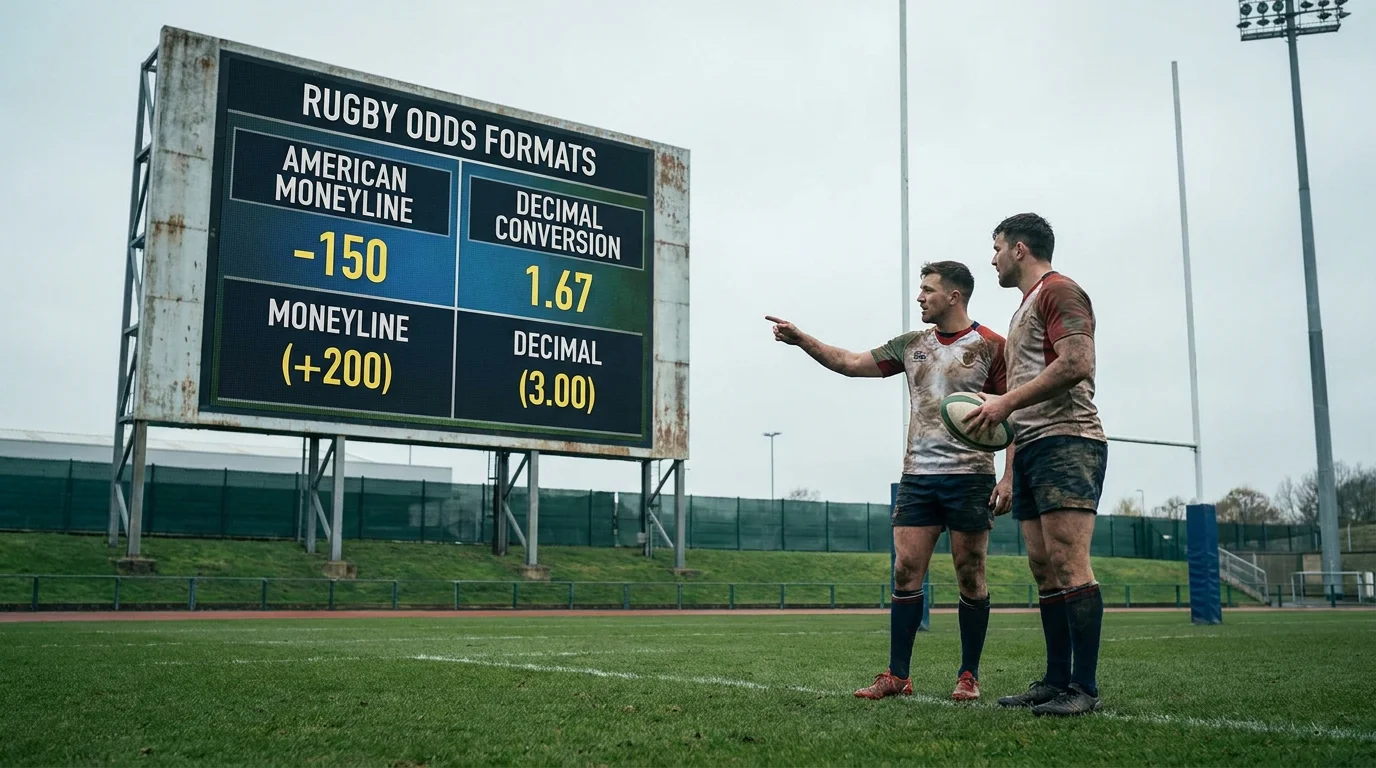
Positive moneyline (+150, +250, +500): the number represents the profit on a $100 stake. So +500 means $100 staked returns $500 profit plus the original stake. Negative moneyline (-110, -150, -300): the number represents the stake required to win $100. So -150 means you need to stake $150 to win $100 profit.
Conversion to decimal. For positive moneyline: (number divided by 100) plus 1. So +250 becomes 3.50 decimal. For negative moneyline: (100 divided by the absolute number) plus 1. So -150 becomes 1.67 decimal.
The format is hostile to mental arithmetic when comparing across both sides of the line — a -110 and a +100 are similar prices but look completely different. UK rugby bettors will rarely encounter American odds on domestic markets, but they appear occasionally on international competitions and on operators with US-facing product lines.
Display settings on UK bookmakers
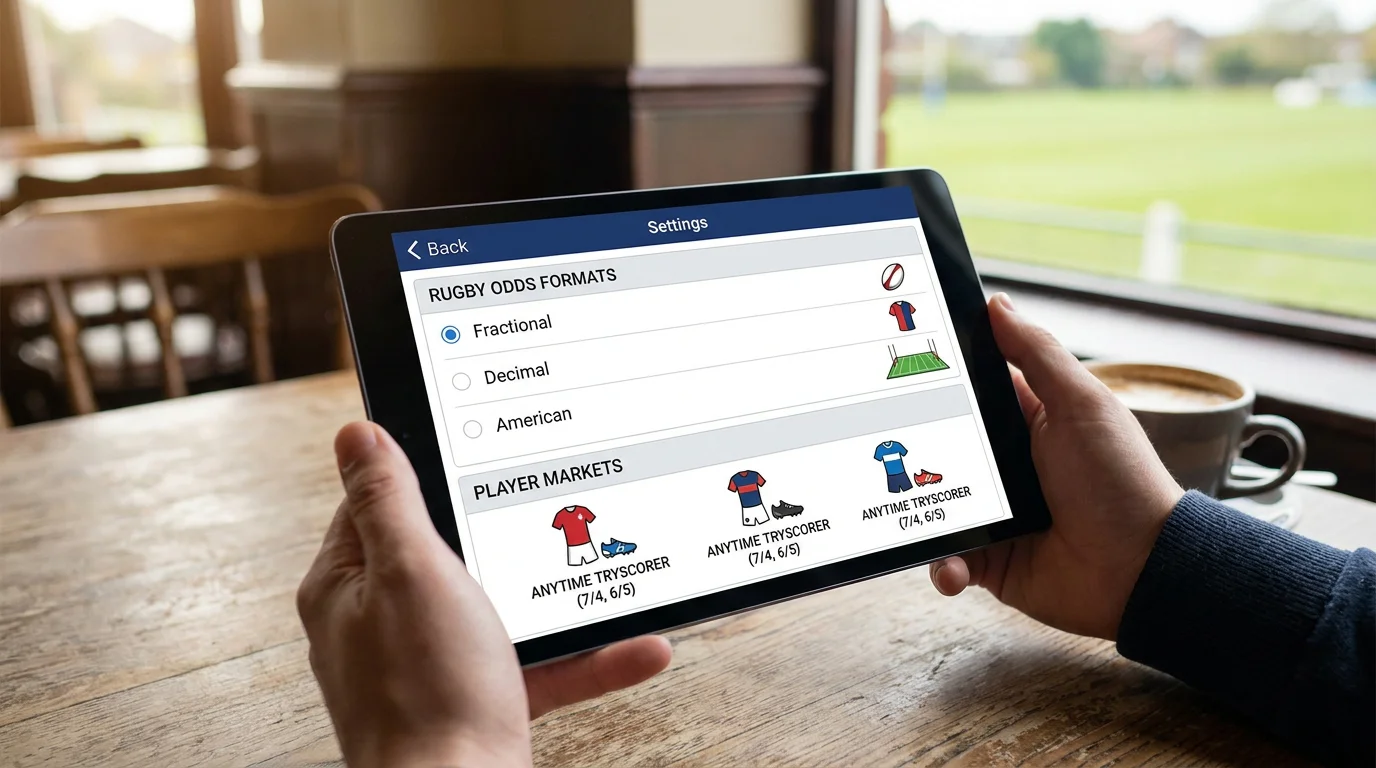
Every major UK bookmaker app has a setting to toggle between fractional, decimal, and sometimes American odds. The default is almost always fractional. The setting persists across sessions on most apps and websites. The change takes seconds and pays dividends across every future bet.
The case for decimal in the UK context. Implied-probability maths is significantly faster. Cross-operator comparison is cleaner — comparing 2.10, 2.05, and 1.95 across three operators is immediately obvious; comparing 11/10, 21/20, and 19/20 takes longer. Bet builder and acca calculations work in decimal natively, since the combined price is the product of individual prices.
The case for fractional. Cultural familiarity for UK bettors who grew up with the format. Better integration with traditional bookmaker terminology — “ante-post specials at 5 to 1” reads more naturally to many UK punters than “ante-post at 6.00 decimal”. For social betting and conversation, fractional remains the default register in the UK.
My recommendation: keep your app set to decimal for analysis and stake selection. Mentally translate to fractional when discussing prices with other bettors who prefer that format. The two-way fluency is useful; one-way fluency in fractional only is genuinely costly when comparing prices quickly.
Quick conversion tricks
The conversions worth memorising. Even-money is 1/1 fractional, 2.00 decimal, +100 American. Odds-on at 50 percent implied probability lands at 1/2 fractional and 1.50 decimal. Round numbers convert easily: 1/1 to 2.00, 2/1 to 3.00, 3/1 to 4.00, 4/1 to 5.00. Each additional point in fractional adds 1.00 to decimal.

Non-round fractional prices that come up regularly. 6/4 is 2.50 decimal. 7/4 is 2.75. 9/4 is 3.25. 11/4 is 3.75. 13/8 is 2.625. 15/8 is 2.875. 11/10 is 2.10. 21/20 is 2.05. The pattern: take the fraction, add 1, and you have the decimal.
For implied probability, the round prices land at memorable percentages. 2.00 is 50 percent. 3.00 is 33.3 percent. 4.00 is 25 percent. 5.00 is 20 percent. 10.00 is 10 percent. The midpoints are useful too: 2.50 is 40 percent, 3.50 is 28.6 percent, 4.50 is 22.2 percent. Memorising these reference points speeds up value assessment significantly.
The format that fits your betting style
Format choice is not value-neutral. Decimal saves time on probability maths; fractional preserves cultural fluency. American is occasionally useful on cross-border markets. The right setting is the one that lets you evaluate prices fastest without making conversion errors. For most UK rugby bettors with any analytical intent, that is decimal — even if fractional remains the default in conversation. Whatever format you use, the underlying maths is identical and the implied probabilities are the same. For the next step, calculating value from those probabilities, see my piece on implied probability calculations.