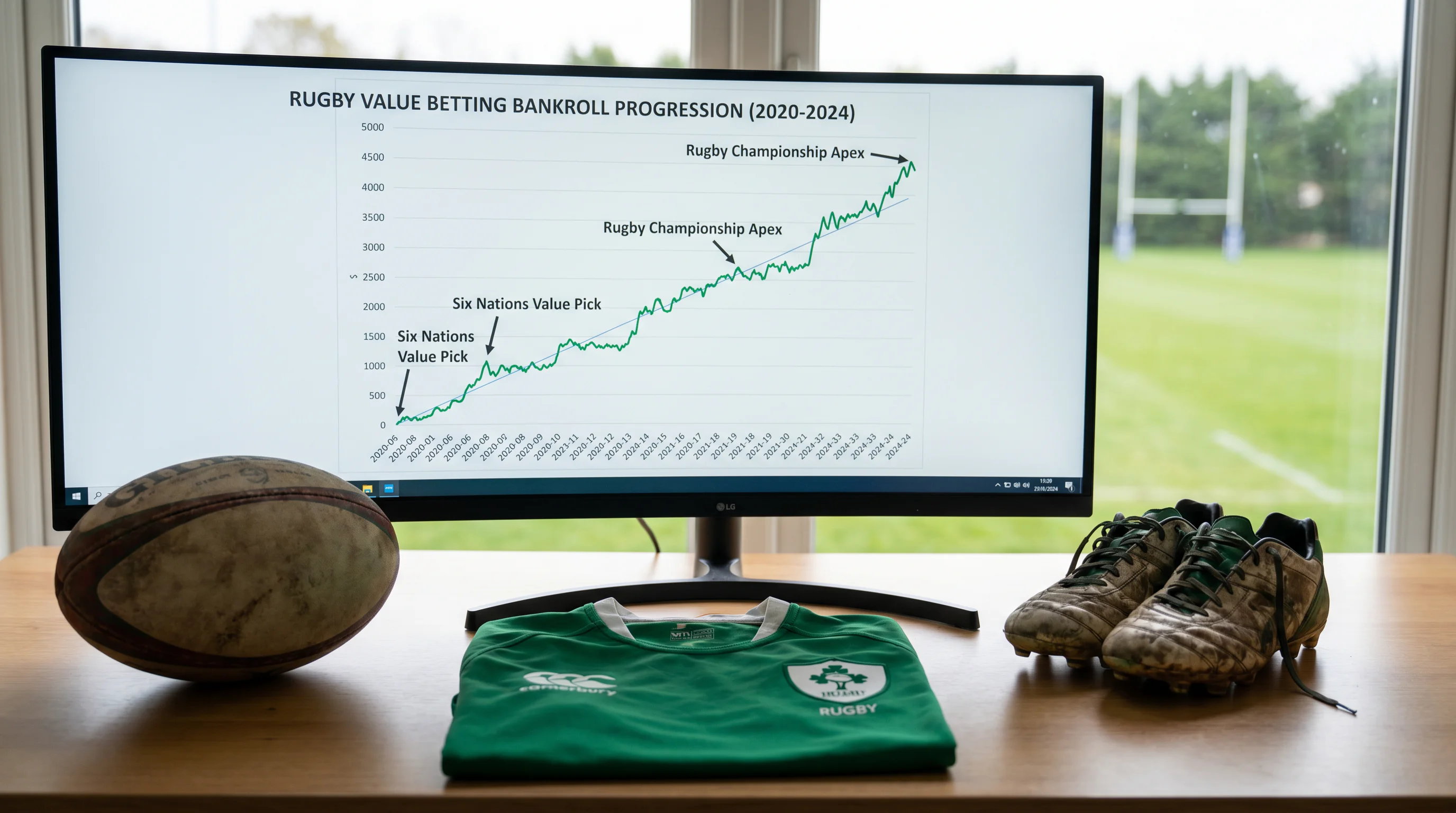
Rugby Value Betting: Implied Probability, No-Vig Pricing, and Finding the Edge
 Available in US
The only concept that turns a hobby into a model
Every rugby bettor I know who has stayed profitable across multiple seasons can articulate value betting cleanly in two sentences. They cannot all build a power rating. They cannot all model live momentum. But they can all explain why a 3.00 price on a 40 percent probability is value and why a 2.00 price on the same probability is not. That clarity is the difference between a model and a hobby.
Value betting is unglamorous. It does not produce highlight-reel wins. It does produce a small positive expected return per bet, multiplied across hundreds of bets a season, that compounds into genuine profitability. The 93-98.5 percent payout range across UK rugby bookmakers tells you the margin you are working against — the operator’s overround. Value betting is the discipline of finding the bets where your modelled probability exceeds the implied probability after accounting for that overround.
Implied probability from odds
The basic conversion. A decimal price of X implies a probability of 1 divided by X. A 2.00 price implies 50 percent probability. A 3.00 price implies 33.3 percent. A 1.50 price implies 66.7 percent. This number is what the bookmaker is asking you to believe about the outcome.
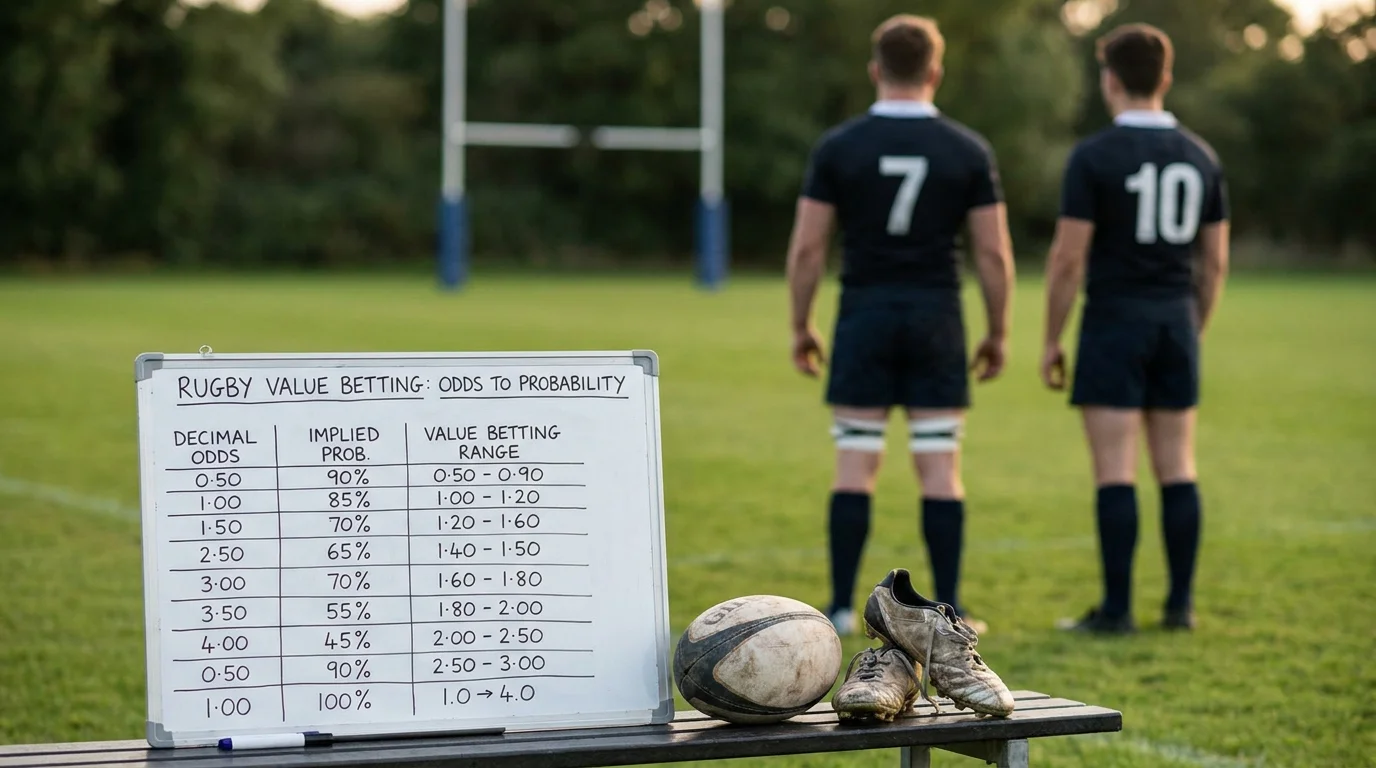
Implied probability is not the bookmaker’s true model probability. It is the probability that makes the price break-even, including the operator’s margin. If the bookmaker thinks the true probability is 50 percent, the offered price will be lower than 2.00 — typically 1.91 to 1.95, where the implied probability is 51.3 to 52.4 percent. The difference is the operator’s edge.
What this means for value calculations. Comparing your modelled probability against the offered price’s implied probability is the wrong comparison. You should compare your modelled probability against the no-vig implied probability — the price’s implied probability adjusted to remove the operator margin. That adjusted comparison is the only honest test of whether a bet has value.
Removing the overround
The overround on a two-way market (like 1X2 without the draw, or handicap with two outcomes) is calculated by summing the implied probabilities of both outcomes. If both prices are 1.91, the implied probabilities sum to 104.7 percent — that 4.7 percent excess is the overround.

To get no-vig prices, divide each implied probability by the overround total. In the 1.91/1.91 example, no-vig implied probabilities are 50/50. Both prices, after removing the operator margin, are saying “this is a 50-50 outcome”.
For a three-way market (1X2 with the draw), the same maths applies but with three outcomes. A 1X2 market with 2.10/3.40/4.20 implied probabilities of 47.6/29.4/23.8 sums to 100.8 percent. The 0.8 percent overround is tight; the no-vig probabilities are 47.2/29.2/23.6. The 93-98.5 percent payout range across UK rugby bookmakers tells you which operators run tight overrounds and which run wider ones.
The practical workflow. For every bet I consider seriously, I calculate the no-vig implied probability from the price, compare it against my modelled probability, and stake only when my probability exceeds the no-vig implied by a clear margin — typically 3 percent or more. Below 3 percent the noise in my own model exceeds the edge.
Kelly and fractional staking
Once you have a value edge, the next question is how much to stake. The Kelly criterion gives a theoretically optimal stake size as a function of the edge and the odds. Full Kelly: stake equals edge divided by (odds minus 1), as a fraction of bankroll.

Worked example. A bet at 2.50 odds where my modelled probability is 45 percent (implied is 40 percent, edge is 5 percent in probability terms). Full Kelly stake: edge (0.05) divided by (2.50 minus 1, which is 1.50) — about 3.3 percent of bankroll. That is a meaningful stake for what looks like a modest edge.
Full Kelly is too aggressive for sports betting because the modelled probabilities are noisier than the maths assumes. Most experienced bettors use fractional Kelly — a quarter or half of the full Kelly stake. Quarter Kelly on the example above would stake 0.8 percent of bankroll instead of 3.3 percent. The lower stake protects against model error while still capturing positive expected return.
The discipline is in not abandoning the fraction. Successful bets generate confidence; losing streaks generate fear. Both can lead to stake-size deviations that wipe out the model’s edge. Sticking to a consistent fractional Kelly across all bets, regardless of recent results, is what makes the maths work in the long run.
Building a simple power rating
The modelled probability has to come from somewhere. The most accessible source is a power rating — a numerical estimate of each team’s strength based on recent match results. The basic recipe: start each team at zero, update after each match by a fraction of the difference between actual result and expected result.
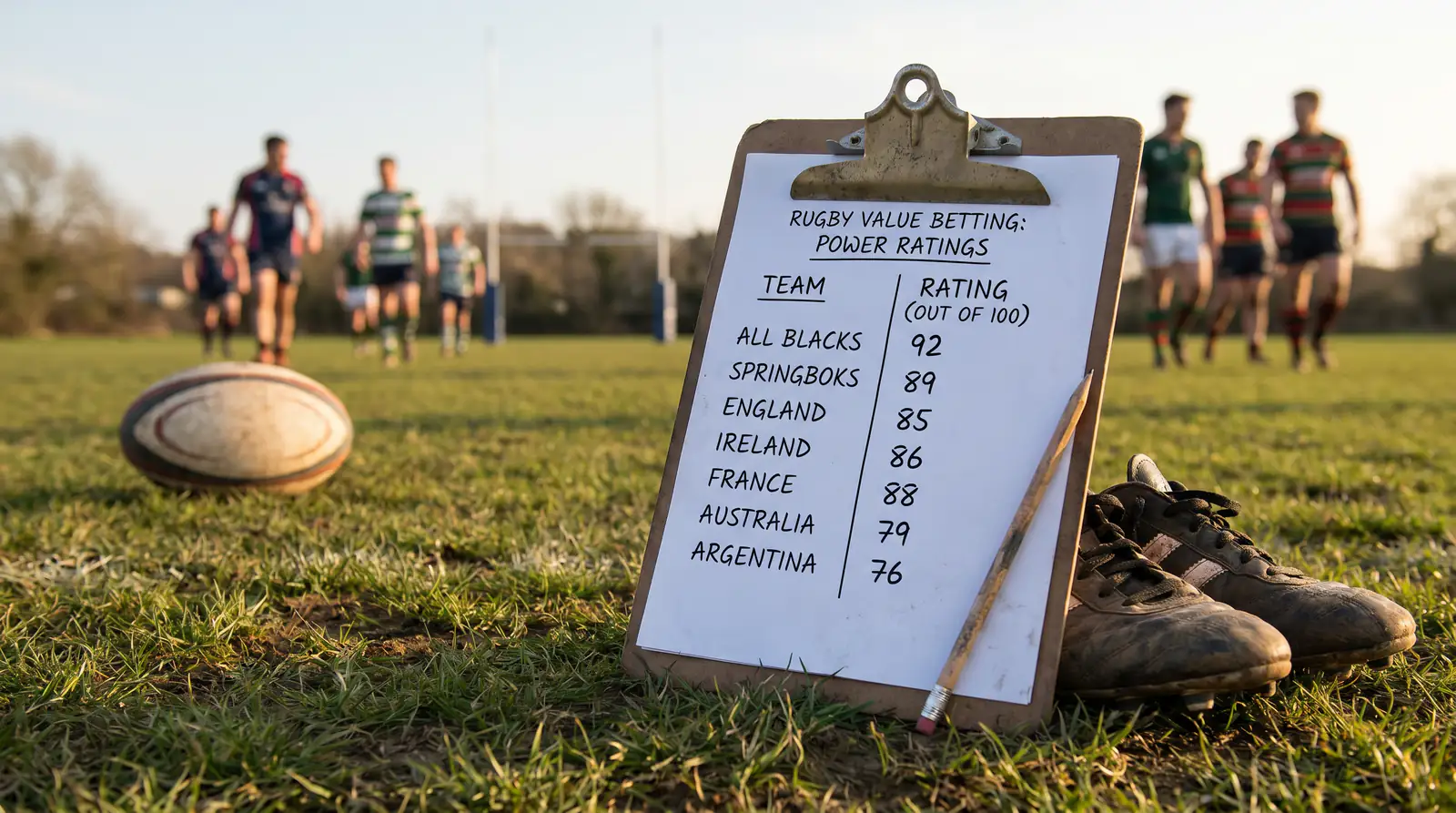
For rugby specifically, the power rating updates use margin of victory rather than just win-loss. A 30-point win against a strong opponent should move the rating more than a 1-point win against a weak opponent. The update equation can be as simple as: new rating equals old rating plus 0.1 times (actual margin minus expected margin, adjusted for home advantage).
The home advantage adjustment matters. Most published systems use 3 to 5 points for elite union, applied to whichever side is at home. The model’s expected margin is the difference in power ratings, plus the home advantage if applicable, plus any other adjustments (travel, weather, rest days).
The output of a basic power rating is a projected margin for each fixture, which converts to a probability distribution over outcomes. That probability distribution is what you compare against bookmaker no-vig prices to find value.
Discipline and record-keeping
Value betting only works if you actually have a positive expected return per bet. Most bettors who think they have an edge do not, because their modelled probabilities are too optimistic about their own picks. The only way to know is to track bets meticulously over a sample large enough to be statistically meaningful.

What I track: every bet, with the price, the modelled probability, the no-vig implied probability, the stake, and the outcome. Aggregating across hundreds of bets shows whether my modelled probabilities are calibrated correctly. If my 40-percent modelled bets win 35 percent of the time, my model is overconfident. If they win 45 percent of the time, my model is underconfident.
The honest assessment usually takes 200 to 300 bets to be meaningful. Bettors who declare themselves profitable after 20 bets have not seen enough variance to know. Bettors who track 200 bets and find their actual return is negative have the painful but useful information needed to fix the model — usually by recalibrating expectations downward.
The patience that compounds
Value betting is a slow product. Small per-bet edges, multiplied across hundreds of bets, produce returns that compound across seasons. The 93 to 98.5 percent payout range across UK rugby bookmakers means the structural margin is small but real, and the discipline of consistently betting above no-vig probability is what captures the edge. None of this is glamorous. All of it works. For the specific mechanics of converting prices into the probabilities you actually need, see my piece on odds formats and implied probability.