
Rugby Spread Betting: Supremacy, Totals, and Per-Point Payouts
 Available in US
The product that looks like betting but is regulated like trading
Rugby spread betting is the strangest corner of the UK market. It looks like a sportsbook product — you place a bet on a rugby match, you win or lose depending on the outcome — but legally it is a financial instrument regulated by the Financial Conduct Authority, not the Gambling Commission. The compliance regime, the risk warnings, and the customer treatment all reflect that distinction. So does the product structure itself.
The first time I traded a rugby spread I won £40 in 90 seconds and thought I had cracked it. By full time I had lost £180 on the same position because the score blew through both ends of the spread. That asymmetric payout — multiplied per point — is the entire feature and the entire risk.
Spread versus fixed odds in rugby
A fixed-odds bet on rugby pays a defined amount if the outcome happens and nothing if it does not. Spread betting pays out per point of difference between your prediction and the actual result, multiplied by your unit stake.
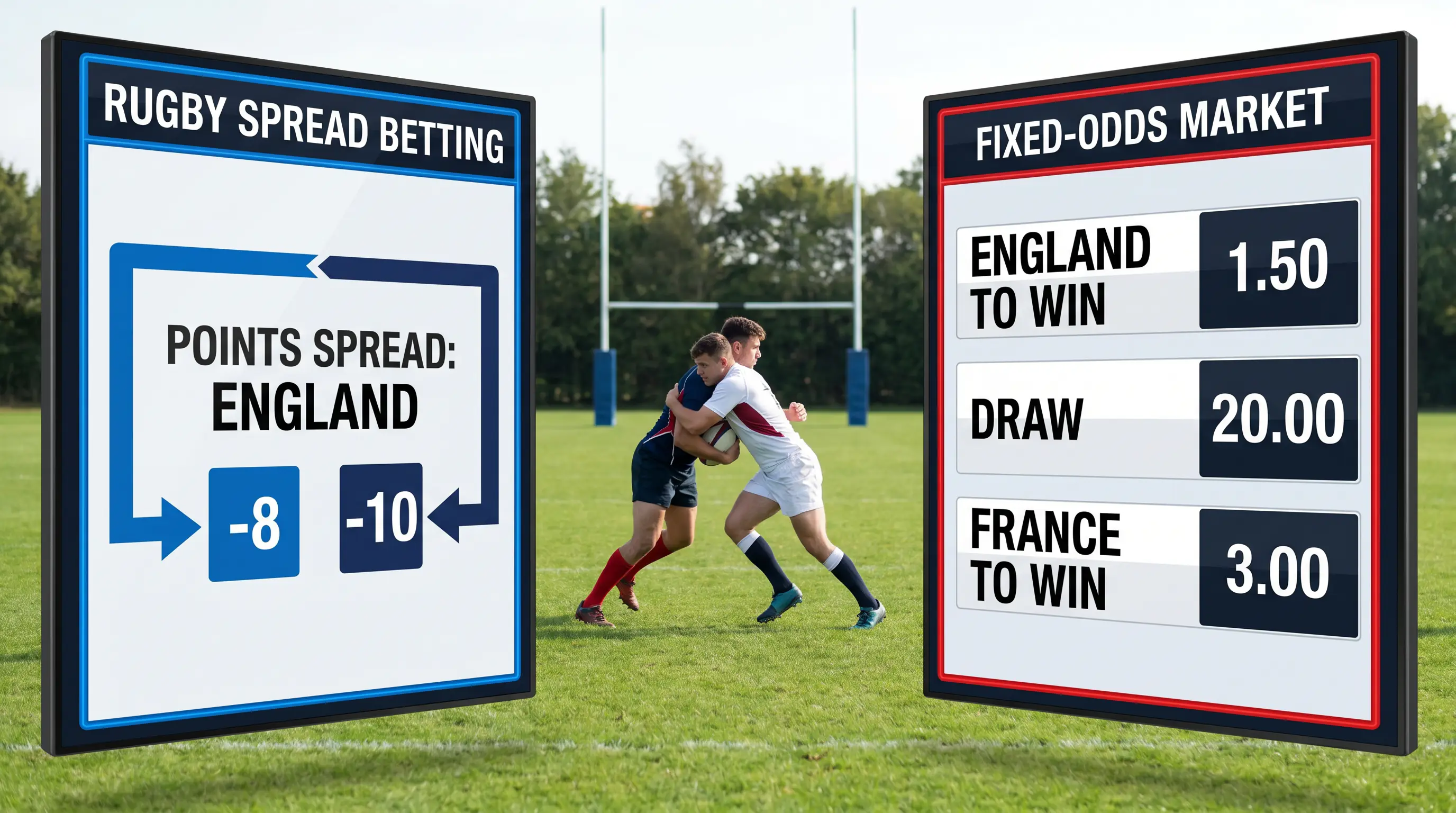
Worked example. The supremacy spread on a Six Nations match might quote England as -4 to -6. If you buy at -6 with a £10 unit, you win £10 for every point England wins by above six. England winning by 12 returns £60 profit. England winning by 7 returns £10. England winning by 5 means you lose £10. England losing the match returns a much larger loss, potentially several hundred pounds depending on the margin.
The trade-off compared with fixed-odds: spreads pay more when you are very right and lose much more when you are very wrong. The structure suits bettors with a confident specific view who can size positions for the worst-case scenario. It punishes bettors who treat it like a standard sportsbook product.
Supremacy and points spreads
Supremacy is the headline spread market — the predicted margin of victory for the favourite. Operators quote a buy and sell range; you buy if you think the margin will be wider, sell if you think it will be narrower (or that the underdog will win, which produces a large negative supremacy).
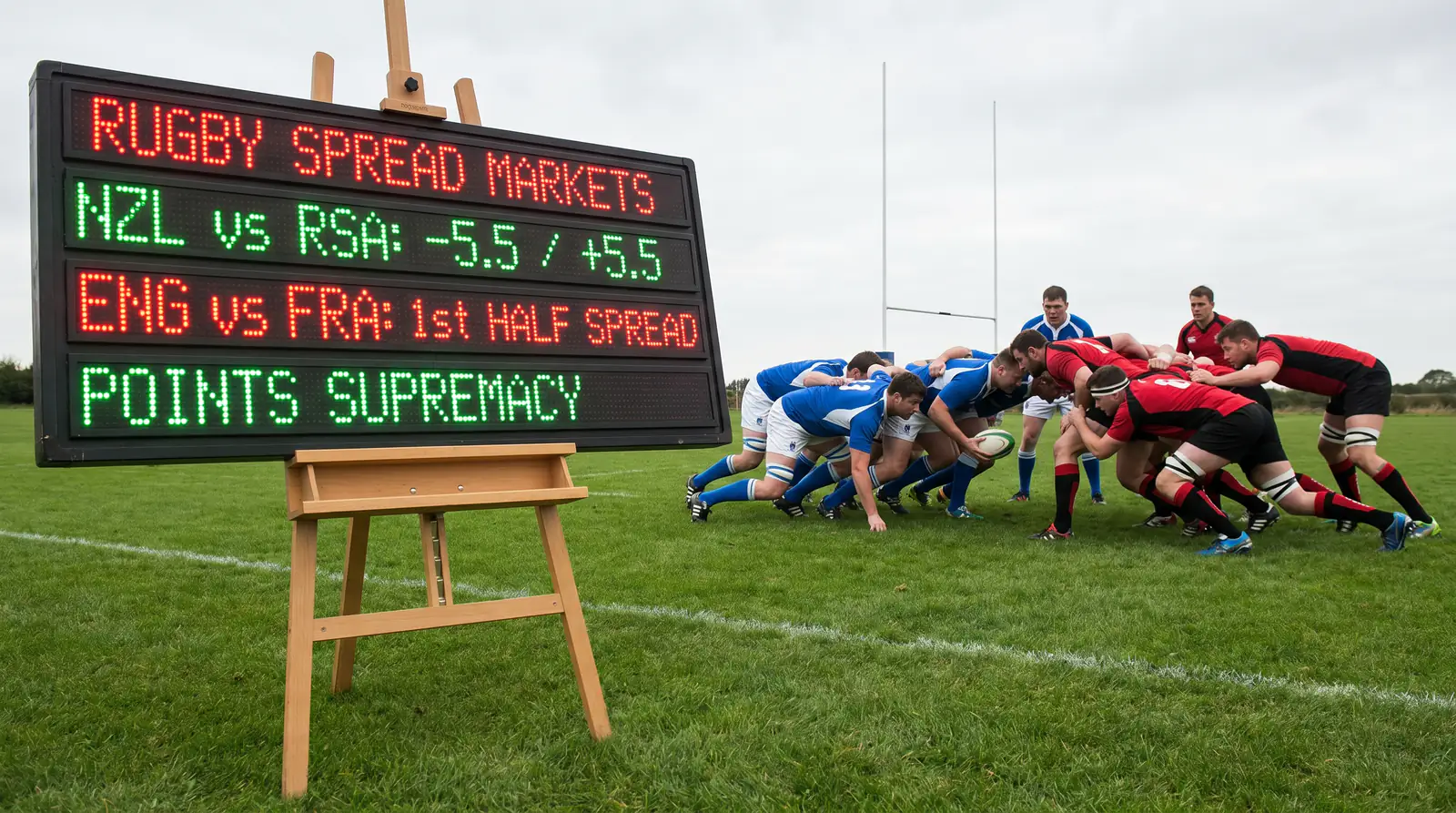
Total points spreads work the same way but on the combined score. Buy if you think the game will be high-scoring, sell if you think it will be low-scoring. The breakeven point is somewhere in the middle of the quoted spread, and your per-point payout is your unit stake multiplied by the distance from the spread.
Risk management on supremacy spreads is everything. A 30-point swing in supremacy on a £10 unit is a £300 outcome. Spread firms typically allow stop-losses to cap downside, but the stop-loss itself usually carries a premium — the wider the spread you allow before the stop triggers, the better the entry price.
Try-time and shirt-number spreads
The more exotic rugby spreads are where the product really differs from fixed-odds betting. Try-time spreads quote the predicted total minutes between the start and end of try-scoring events, summed across both sides. Shirt-number spreads quote the sum of jersey numbers for all try scorers in the match.
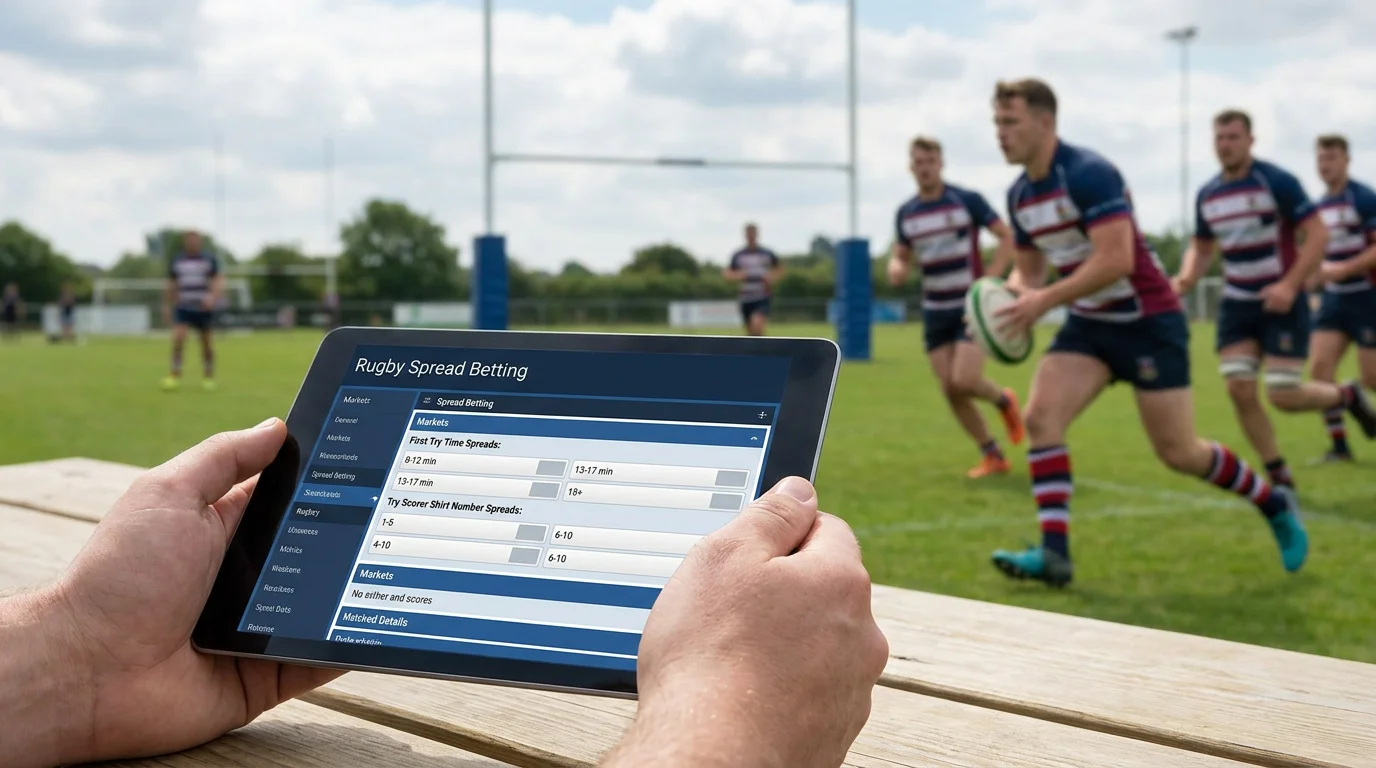
Try-time is the most interesting from a strategy perspective. A buy on try-time benefits from late tries — the later the scoring, the higher the cumulative minute total. A sell benefits from early tries. The market rewards a specific view about scoring distribution, not just whether tries happen.
Shirt-number spreads are essentially a position on which positions score. Backs typically wear higher numbers (11-15) than forwards (1-8), so a buy on shirt-numbers benefits from outside-back tries. Given that 66 percent of Six Nations 2023 tries came from three-quarters, shirt-number buys have a structural lean toward profitability when forwards are not heavily favoured to score.
Risk management on spreads
The single most important thing to understand about spread betting is the worst-case scenario per position. A £10 unit on a supremacy spread can produce a £400 loss if the result blows through both ends. Bettors who do not size positions for the worst case end up with painful surprises.

The practical rules I apply. Never trade a unit size that produces a worst-case loss above 2 percent of your spread betting bankroll. Use stop-losses on every supremacy position to cap the downside at a known number. Avoid try-time and shirt-number positions in matches where you do not have a clear specific view — the variance is too high to take generic positions.
Margin requirements also matter. Spread firms require margin to open positions, and the required margin scales with the implied worst-case loss. Bettors who open multiple positions can find their available margin exhausted faster than expected, which can force liquidations at the worst moments.
FCA regulation and what it means
The FCA-regulated status of spread firms changes the customer experience in several ways. KYC requirements are stricter, appropriateness tests are mandatory before account opening, and the products carry standardised risk warnings about the potential for losses to exceed deposits.
The taxation treatment differs from fixed-odds betting. Both are tax-free for UK residents, but the regulatory framework around dispute resolution, complaints, and account closure runs through FCA rules rather than the Gambling Commission. That is generally a positive — the FCA framework is mature and well-tested — but it means the dispute path looks different if a complaint arises.
The other practical effect: spread firms are smaller operators than the major fixed-odds bookmakers. There are only a handful of UK spread firms offering rugby markets, and the prices across firms tend to converge tightly because the player pool is smaller and the arbitrage opportunities are easier to exploit.
Where spread betting fits in a rugby bankroll
Spread betting is not a substitute for fixed-odds rugby betting. It is a complement for bettors with specific match views who want asymmetric payouts. The right share of bankroll allocated to spreads depends on personal risk tolerance, but for most bettors it should be a small slice of total rugby capital — perhaps 10 to 20 percent at most.

The use case I keep coming back to: matches where I have a confident view on the magnitude of an outcome, not just the direction. If I think a side will win by 15 to 25 points, buying supremacy at a -10 spread offers a much better payout than a handicap bet on the same scenario. The maths works when the conviction is genuine. The maths bites when the conviction is wishful. For the operator-side taxation differences that contrast spread firms with fixed-odds bookmakers, see my piece on rugby betting taxation in the UK.
