
Rugby Winning Margin Betting: Banded Markets and Mismatch Pricing
 Available in US
The market that rewards you for being specific
If handicap is a coin flip with extra steps, winning margin is the bet where being right specifically actually pays off. Instead of asking “does the favourite cover seven points”, the market asks “by how much exactly”. The trade-off is brutal — you need a better read, and the overround is higher — but the prices are genuinely generous when you can narrow the band correctly.
I use winning margin in two situations: clear mismatches where I think the favourite scores too freely to be capped by the handicap line, and tight matches where I expect a low-scoring grinder that no other market prices well. Most other situations are not worth the overround.
Band structure and typical prices
Most UK bookmakers offer winning margin in three or four bands per team plus a draw. The standard split: 1 to 12, 13 to 24, 25-plus, plus the same bands for the underdog and a draw option. Some operators run finer bands — 1 to 5, 6 to 10, 11 to 15 — for marquee fixtures where the margin discovery is more granular.

Typical pricing on a clear favourite expected to win comfortably. Favourite by 1 to 12: roughly 2.30 to 2.80. Favourite by 13 to 24: roughly 3.20 to 4.00. Favourite by 25-plus: roughly 4.50 to 7.00, depending on the size of the mismatch. Underdog wins: rarely under 4.50 in a real mismatch. Draw: 18.00 to 26.00.
The overround across all seven or eight outcomes typically runs 115 to 125 percent — wider than handicap, narrower than try scorer. The wider margin is the price you pay for the more specific selection. The narrower margin is the gift you get for not picking exactly one outcome.
Winning margin versus handicap tradeoffs
Direct comparison: a handicap bet at -7.5 priced at 1.85 on a clear favourite. The equivalent winning margin bet for the same favourite winning by 1 to 12 might price at 2.50. Both bets win in roughly the same scenario, but the winning margin bet pays out more — at the cost of losing in additional scenarios (a win by exactly 13 to 24 ruins the winning margin bet but the handicap bet still wins).

When does winning margin offer better value? When your match read is specific. If you think the favourite wins by exactly 8 to 12, the winning margin band is the right bet. If you only think the favourite wins by more than 7.5 without a clear band view, handicap is the right bet.
The corollary: avoid winning margin when you do not have a tight view. The wider overround eats your edge if you are picking the band based on a soft read. Stick to matches where you can articulate why the result will land specifically in one band.
Mismatch pricing: Six Nations tier-1 versus Italy
The cleanest worked example sits in the Six Nations. England, France, Ireland against Italy — the historical record shows wide-margin wins more often than the handicap line credits. Across the recent Six Nations samples (1,050,465 attendance across 15 matches in 2025, 995,964 across 15 matches in 2026 with 111 tries), the tier-1 versus Italy fixtures regularly produce winning margins above 25 points.

The 25-plus band is where the value sits in these fixtures. Bookmakers price the band to reflect a balanced expectation — perhaps 30 to 40 percent implied probability of a 25-plus win for the favourite. The historical strike rate in these specific matchups runs closer to 50 percent or higher, depending on the form window. The gap between implied probability and actual probability is the edge.
A note of caution: tier-1 versus Italy is not always a blowout. Italy has produced genuinely competitive matches in recent campaigns, and assuming the 25-plus band as a default is lazy modelling. The right approach is to look at squad rotation, weather, and venue specifically — sometimes the band is the right pick, sometimes it is not.
Combining winning margin with totals
Winning margin and total points correlate, and bet builders that combine them can produce edges when the operator does not price the dependency. A favourite winning by 25-plus is most likely in a high-scoring match — that match also clears the totals over. A combined ticket on “Team A by 25-plus” and “Over 48.5” has overlapping conditions and should be priced lower than independent multiplication suggests.
Operators that use simple multiplication offer better odds on these correlated combos. The maths: if Team A by 25-plus prices at 4.50 and over 48.5 prices at 1.95, simple multiplication gives 8.78. Correlation-aware pricing might price it at 6.50 to 7.20. If you can find the 8.78 price, the implied probability is too low and the bet is genuine value.
Historical band distribution
Across the recent Six Nations sample, with 111 tries scored across 15 matches and 66,398 average attendance per fixture, the band distribution for non-mismatch fixtures clusters in the 1 to 12 range. Roughly half of all completed Six Nations matches over the past several campaigns have ended within 12 points. That is the modal outcome.

The 13 to 24 band captures another large slice — perhaps a quarter of fixtures. The 25-plus band captures most of the tier-1 versus Italy results plus occasional blowouts elsewhere. The draw remains rare at the elite level but is not impossibly rare, particularly in tight derby fixtures.
What this means for staking: the 1 to 12 band is the modal outcome but also the most heavily priced by operators. Edge in that band requires a specific read. The 25-plus band is where mispricing tends to favour the bettor, but only in fixtures where the historical pattern supports the wider margin.
Live winning margin trading
In-play winning margin markets get more complicated than other live markets because the bands shift as the score develops. A live “winning margin between 13 and 24” market opens fresh after each scoring play, with the current scoreline factored in.
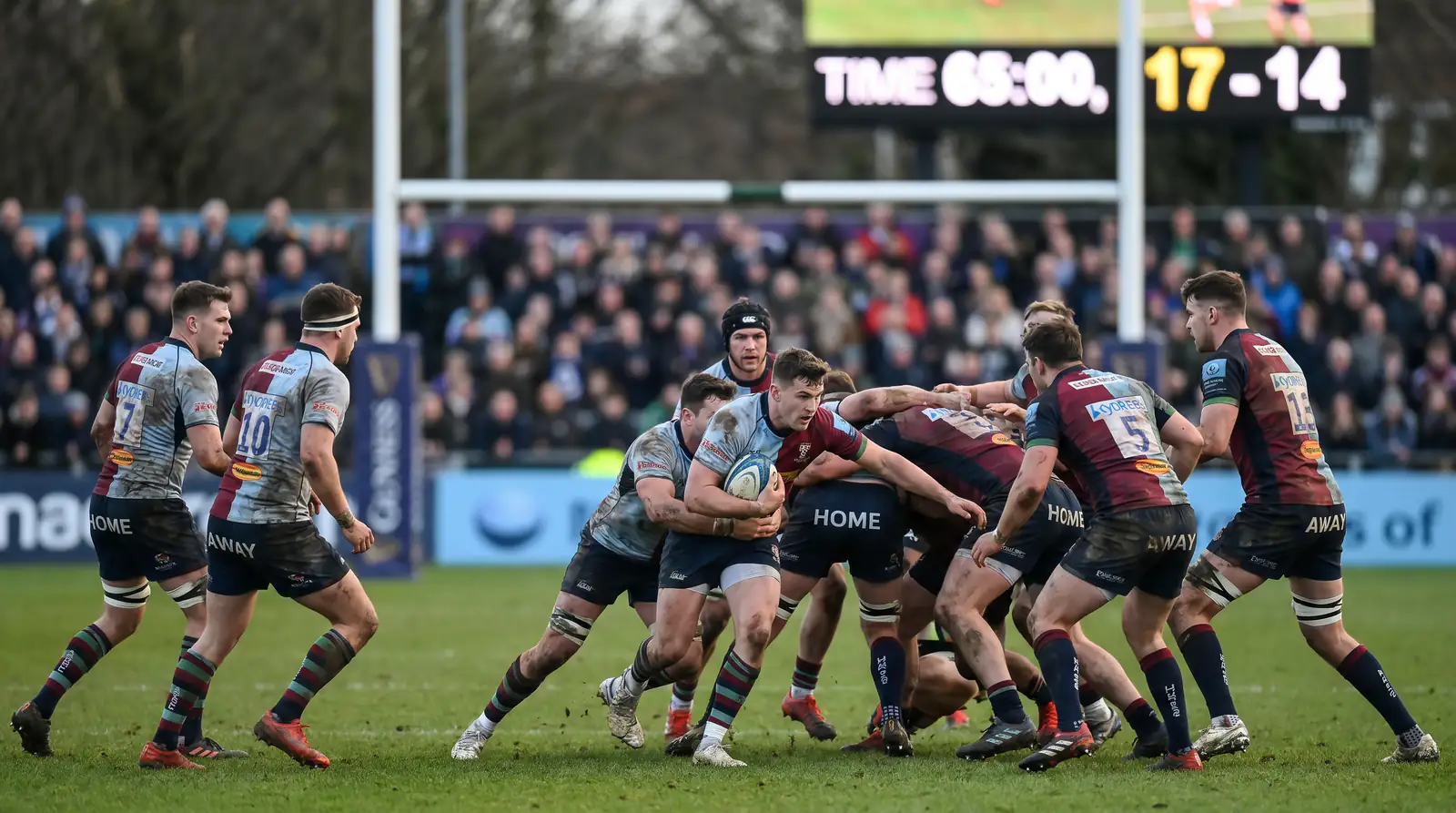
My approach: I rarely trade winning margin live. The overround is wider than handicap and the line discovery during the match is noisier. The only live winning margin bet I take regularly is in matches where a sudden swing has pushed the live line into territory that does not reflect the underlying score — for instance, a quick try in the 50th minute that opens an unfamiliar live 13-24 band at generous odds.
Where the market makes most sense
Winning margin is a precision tool. It rewards specific reads in specific matches — tier-1 versus Italy in the Six Nations, mismatched Champions Cup pool fixtures, knockout games where one side is rotating starters. Used outside those windows it bleeds capital to overround. Used inside them it pays better than handicap by a meaningful margin. For the broader market context that informs my reads, my piece on rugby handicap betting covers the same fixtures from a different angle.