
Rugby Handicap Betting: Reading the Lines and Beating the Spread
 Available in US
What the handicap actually represents
A handicap line is a story the bookmaker tells about a match before kick-off. It compresses everything — current form, home advantage, weather, squad rotation, historical head-to-head — into a single number. Beat that number consistently and you have a profitable model. Beat it occasionally and you have a hobby.
As one industry summary put it, the best rugby betting sites in the UK cater to both union and league fans, spanning competitions like the Rugby World Cup, Six Nations, Gallagher Premiership, Super League, and Challenge Cup, with markets that include handicaps, first try scorer, winning margin, and total points. That breadth tells you something practical: handicap is the headline market across every competition I cover, and the lines move differently in each one. A Six Nations handicap behaves differently to a Super League handicap, and treating them with one model is a fast way to lose money.
How the line is built
Bookmakers start with a power rating for each side — a numerical estimate of their strength, often calibrated against the past 12 to 24 matches with recency weighting. The difference between two sides’ power ratings, adjusted for home advantage (typically 3 to 5 points in union, 2 to 4 points in league), produces the opening handicap.

That number then gets nudged by the market. Sharp money on one side moves the line; public money moves it less but moves it consistently. By the time the line opens to the average bettor it has often already absorbed the first wave of professional staking. The line you see at 9 a.m. on match day is different from the line that opened on Tuesday morning, and the difference is information.
Half-point hooks (4.5 instead of 5) exist for one reason: to eliminate the push. A 5-point favourite who wins by 5 produces a refund on a 5-point spread but a clear loss on 4.5. Bookmakers strongly prefer non-half-point lines on standard markets and half-point hooks on alternative lines — that asymmetry is part of the pricing structure, not an accident.
Typical line ranges in union and league
Six Nations handicap lines typically sit between 3.5 and 14.5 points for in-form fixtures. Italy fixtures push wider, often 18.5 to 25.5 when facing top-three sides. Total points lines in the Six Nations cluster around 42.5 to 45.5 — a useful sanity check, because handicap and total are linked.
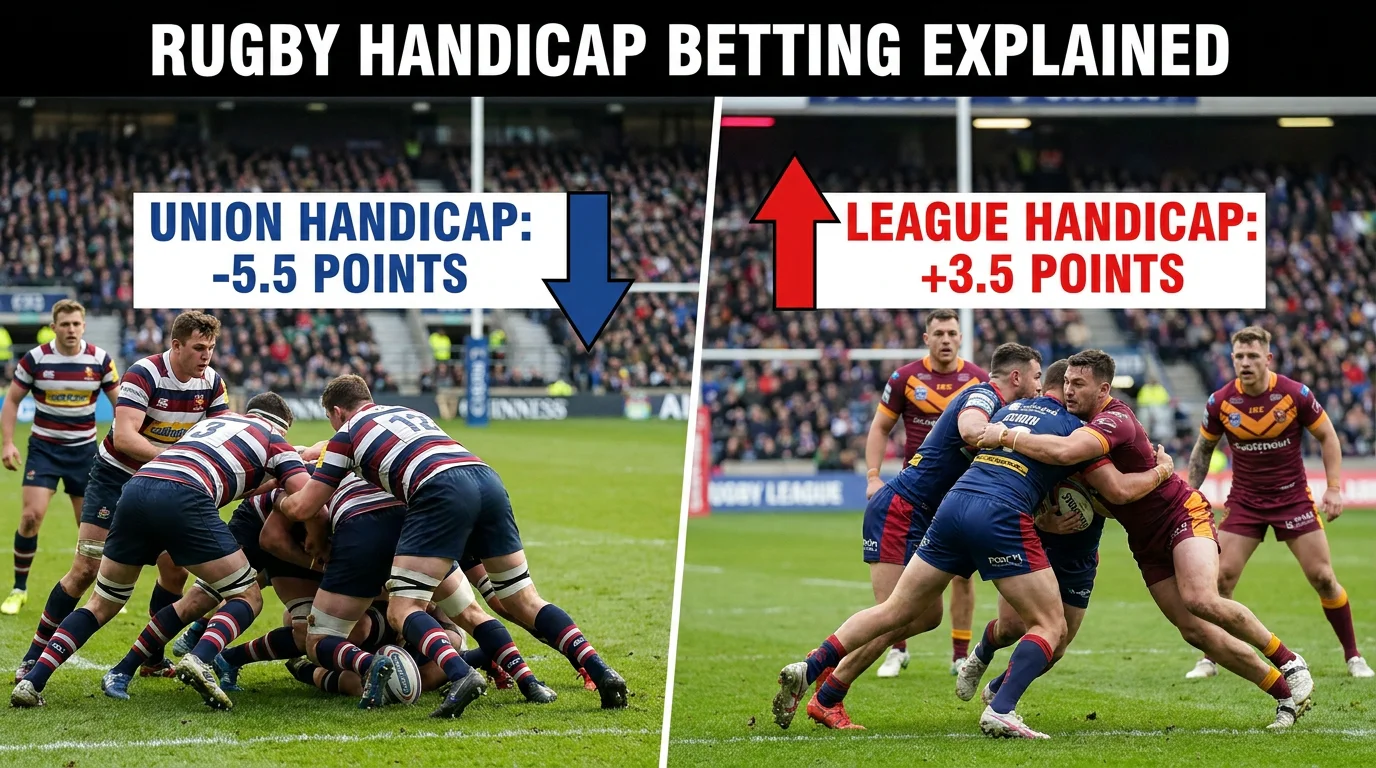
Premiership handicaps usually run 4.5 to 14.5; URC lines can be slightly wider because of the cross-border travel component; Champions Cup pool stage handicaps run wide in mismatches and tight in derbies.
Super League handicaps almost never exceed 18 points and most cluster between 4 and 12. The compressed range is partly the play-the-ball structure keeping possession even, partly the smaller talent gap between top and bottom of the league. Knowing this matters: a 14.5-point line in Super League is genuinely wide and bookmakers do not set those lightly.
What I do with these ranges: anything outside the typical band triggers a closer look. A 20-point Super League handicap is unusual and signals either a specific squad rotation issue or a market mispricing — both worth investigating.
Alternative handicap lines and when to use them
Alternative handicaps let you trade off probability against payout. A standard 7.5 line might price the favourite at 1.85; the same favourite on a 12.5 alternative line might price at 2.50 or higher. The break-even maths is simple, but the value question is harder: do you actually believe the favourite covers by 13 or more?

The trap I see most often: bettors buy down the line for a longer price without checking whether the implied probability is actually achievable. Pushing from 7.5 to 12.5 in a match where the underdog is competitive is not a value bet — it is a sentimental bet. The right time to push the alternative line is when the favourite is rotating bench players against a tired opponent, or when weather conditions favour the favourite’s style.
Buying the alternative line in the other direction — taking the underdog at a wider spread for a shorter price — has its place too. The use case: a tight match where you believe the underdog will keep it close but not necessarily win. A +12.5 underdog at 1.65 can be sound value when the bookmaker’s modelled probability of cover is closer to 65 percent.
Line movement and sharp money
The single most useful habit I built early on was tracking opening lines against closing lines across multiple operators. The closing line is the market’s best estimate of the true result; the opening line is the bookmaker’s initial guess. The gap between them tells you where the sharp money landed.

What to read into the movement. A line that moves from -7.5 to -5.5 indicates significant money on the underdog — the bookmaker is reducing the favourite’s edge to balance the book. A line that moves the other way, from -7.5 to -9.5, suggests money on the favourite, often from sharp accounts who model the match more aggressively than the opening number reflected.
Following the closing line is not a guaranteed profitable strategy — bookmakers know which accounts are sharp and adjust accordingly — but it is a useful sanity check. If your model says -10 and the closing line is -5, your model is probably wrong about something specific that the market priced in.
Bankroll discipline and line shopping
The two habits that have made the biggest difference to my long-term handicap profit are unrelated to model quality. Bankroll discipline — staking a consistent fraction of capital per bet, never doubling up after losses — keeps you alive long enough for the model to express itself. Line shopping — taking the same handicap at the best available price across operators — adds genuine basis points to your edge across a season.

A worked example: betting £100 to win on a -7.5 handicap at 1.85 returns £85. The same bet at 1.95 returns £95. Over 200 bets a year, that 5p-per-£ difference compounds into hundreds of pounds even after losing bets cancel out. Line shopping is unglamorous and it works.
Pulling the threads together
Handicap betting in rugby is the single market I have stayed disciplined with longest, because the structure rewards consistent process. Power ratings, home adjustments, line movement, alternative-line pricing, and bankroll fractional staking — none of them is magic, but the combination is genuinely a model. The breadth of markets across union and league means you can run that process across competitions year-round, which is exactly what serious bettors do. For a deeper look at the operator side, see my piece on line shopping for rugby bets.